There are several types of container cranes. Different types of cranes are designed for specific scenarios. Their working heights and travel methods differ. If you only understand the working conditions but not the types of cranes, it can lead to high modification costs, wasteful procurement, and incompatible civil engineering foundations. This article will tell you what types of container cranes there are and how to choose them.
What Is a Container Crane?
Container cranes are not ordinary overhead cranes used for lifting steel. They are large cranes specifically designed for lifting containers. They are equipped with a special square-frame spreader. The spreader is lowered onto the top of the container. The container has pre-drilled holes at its four corners. These holes allow the container to rotate and are locked in place by the spreader. The container is lifted after the spreader locks into the metal holes. Suitable for use in ports, docks, container yards, and open, windy environments.
What Are the Different Types of Container Cranes?
Ship-to-Shore Container Crane (STS)
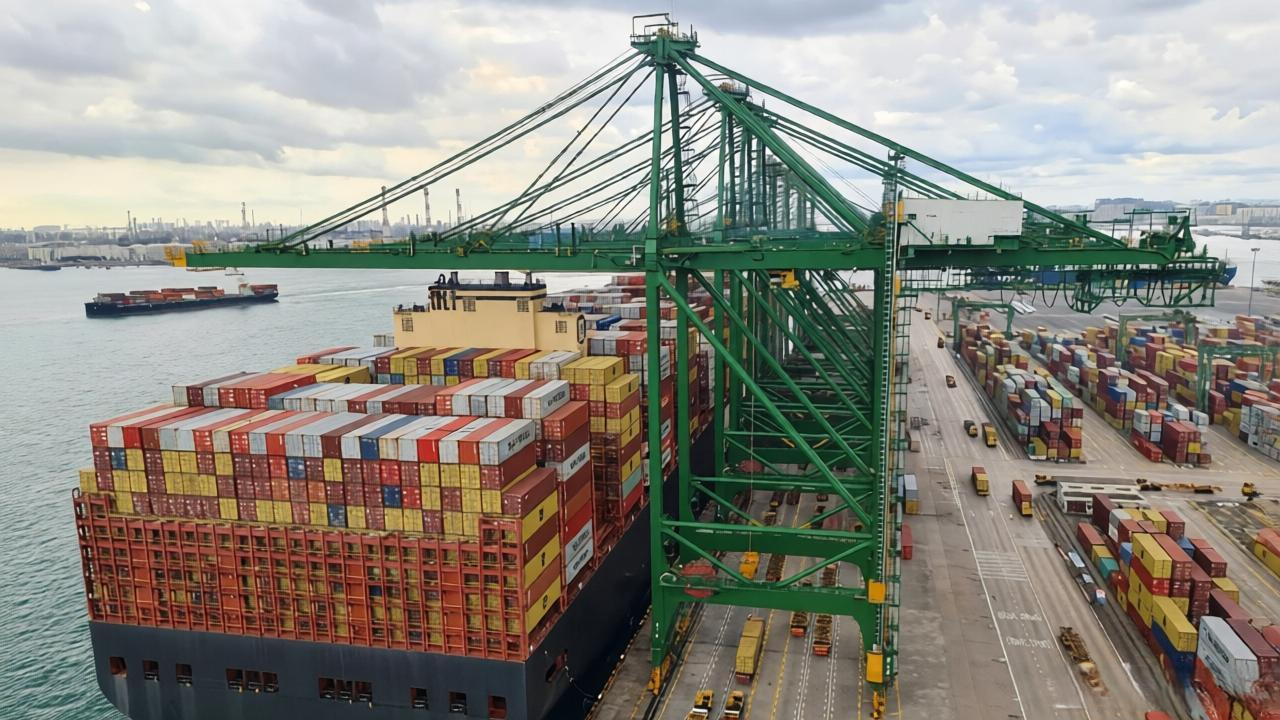
The Quay Crane is the largest and most important machine at the dock; it is a crane that transports goods from ships to shore. When you use an STS, the equipment moves back and forth along tracks on the quay.
It extends a long beam above the sea surface. Container handling is accomplished by trolleys moving back and forth along the horizontal beam. The entire gantry itself does not rotate. Without it, you cannot unload containers from shipping ships onto shore, nor can you load containers from shore back onto shipping ships.
An STS quay crane can help you complete 30-60 moving jobs per hour. For example, hoisting a box from the ship to the shore counts as one job. Hoisting a box from the shore back to the ship also counts as one job. In reality, due to waiting time or weather conditions,
The number of moves may be less than this. The more quadruple cranes you have, the faster your shipments will be.
You’ll handle more containers. The fewer ship-to-shore container cranes you have, the longer large ships will wait, and the fewer containers you can handle per day. If you require fewer personnel to operate the equipment, you can choose a fully automated STS quay crane. This not only reduces personnel waiting time but also reduces losses due to operational errors.
Mobile Harbour Crane(MHC)
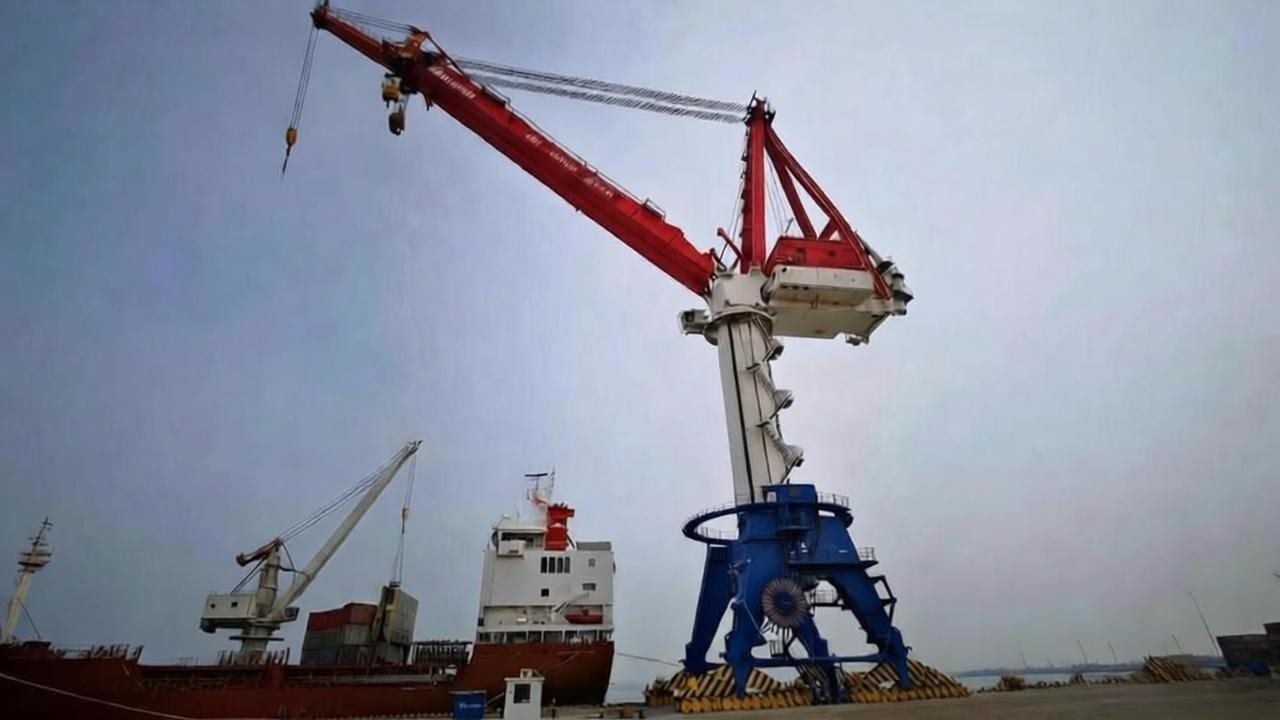
The MHC functions similarly to the STS. However, it requires heavy-duty rubber tires. It can move to different locations on the dock without needing tracks. You can adjust the MHC’s large, angled boom to change its elevation angle. Adjusting the boom’s extension distance and height allows for the lifting of cargo at different locations.
For multi-berth operations, you would need to purchase multiple STS units. However, MHC units can shuttle between different vessels. They can achieve multi-berth operations. They can handle 15-30 loads per hour, making them suitable only for small- to medium-sized, low-frequency handling tasks.
Rubber Tired Gantry Crane (RTG)
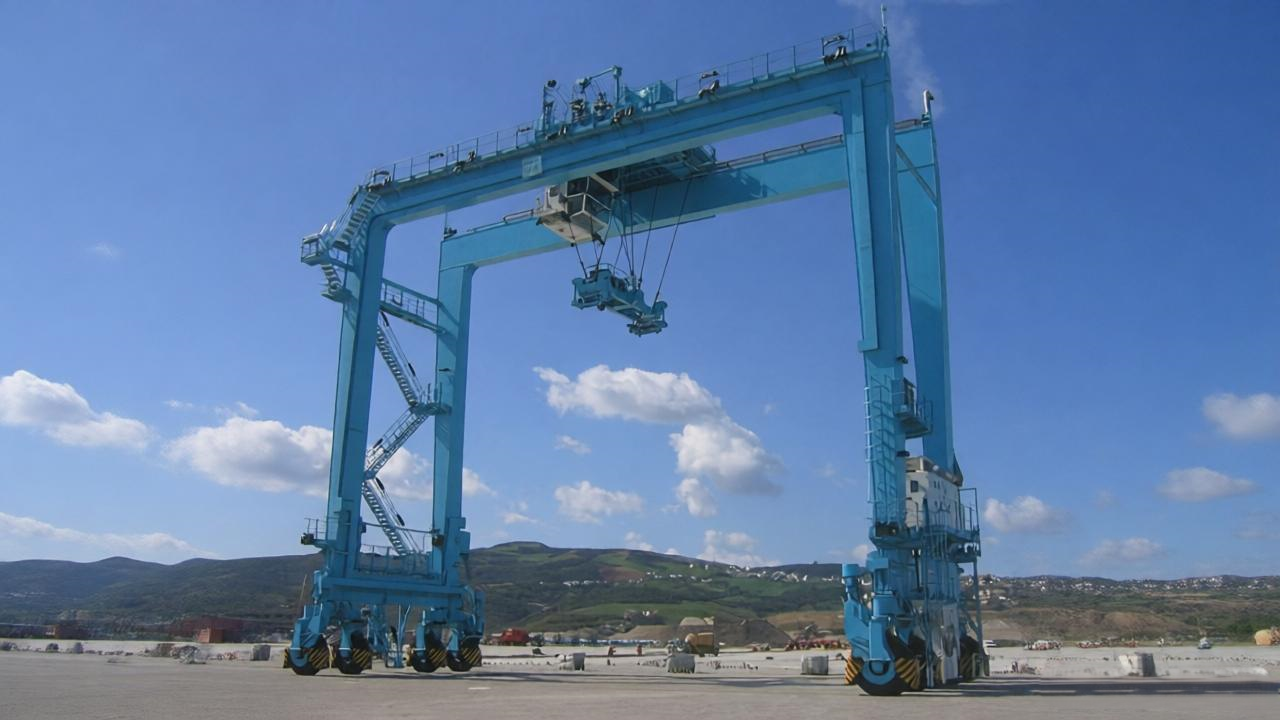
RTG travels on the ground using solid rubber tires. After the quay cranes unload the containers, trucks transport the containers to the yard. At this point, you can use RTGs.
To move the containers from one area to another. They can maneuver freely and are not limited by site constraints. They can be used in small to medium-sized terminal yards.
The core configuration of the RTG equipment includes a gantry steel structure, lifting trolley, hoisting mechanism, control system, specialized spreader, and safety devices. You need to regularly check the tires for replacement to ensure safer equipment operation. The equipped specialized spreader can carry a container load of approximately 70 tons.
The equipment’s working class is A6-A7. Sufficient lifting height. It can accommodate 5 to 7 layers of containers, maximizing space utilization. Meanwhile, the equipment’s travel speed can reach 60-70 m/min. This can effectively improve your work efficiency. Automated management is very difficult, and positioning accuracy is not high.
Rail Mounted Container Gantry Crane
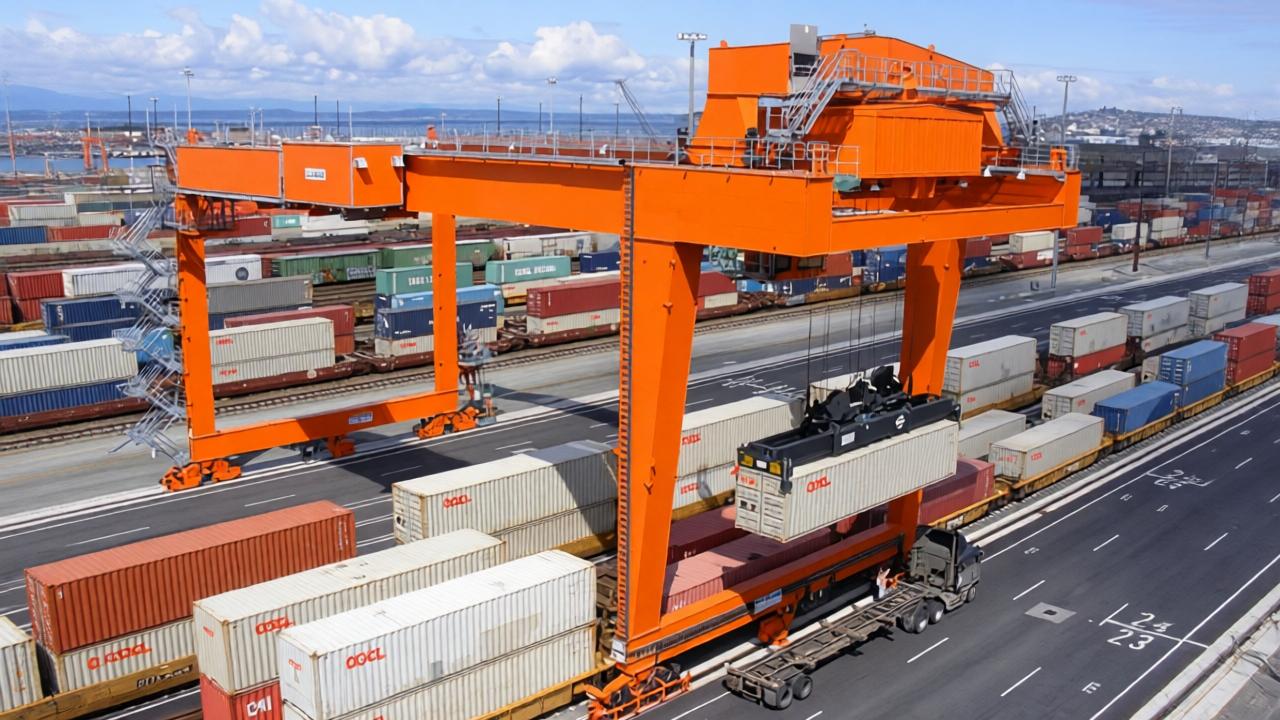
The Rail Mounted Container Gantry Crane moves solely on laid tracks. The positioning accuracy is very high. Furthermore, its lifting height is higher than that of an RTG. It’s approximately 6-8 container heights. Custom sizes of 100 tons and above can be made.
After you drive the large truck to the waterfront to pick up the containers, you drive away from the waterfront. You park under the RMG gantry.
Then the RMG lifts the containers from the truck. Stack them up layer by layer. Neatly placed on the yard floor. Awaiting further transport. Alternatively, you can use an alternative workflow: The RMG lifts the containers from the yard onto trucks, which then transport them to the vicinity of the quay crane. Waiting to be loaded onto a shipping vessel.
Difference Between RTG, RMG, MHC, and STS Cranes?
STS and MHC have the same function, as do RMG and RTG, but they are all container cranes.STS/MHC needs to work in conjunction with RMG/RTG to complete a full port handling operation.
Differences between STS and MHC
STS and MHC have the same function. Both can load and unload large ships at the seaside.
The specific differences are shown in the table below.
| Comparison | STS | MHC |
| Work area | Fixed on one berth | Fully mobile, can drive to different berths to work |
| walking style | Fixed quay rails cannot move freely | Rubber tire driving, no fixed rails needed |
| Structure Feature | Flat luffing boom stretching over the sea | 360° rotating luffing boom, multi-functional design |
| Working Efficiency | Very high, supports large-volume, fast container handling | Medium efficiency, lower than |
| Cargo Type | Only for standard container operation, professional for large vessels | Supports container, bulk cargo, and general cargo |
| Adapted for docks | Large professional container hub terminals | Small & medium multi-purpose ports, inland ports |
Differences between RMG and RTG
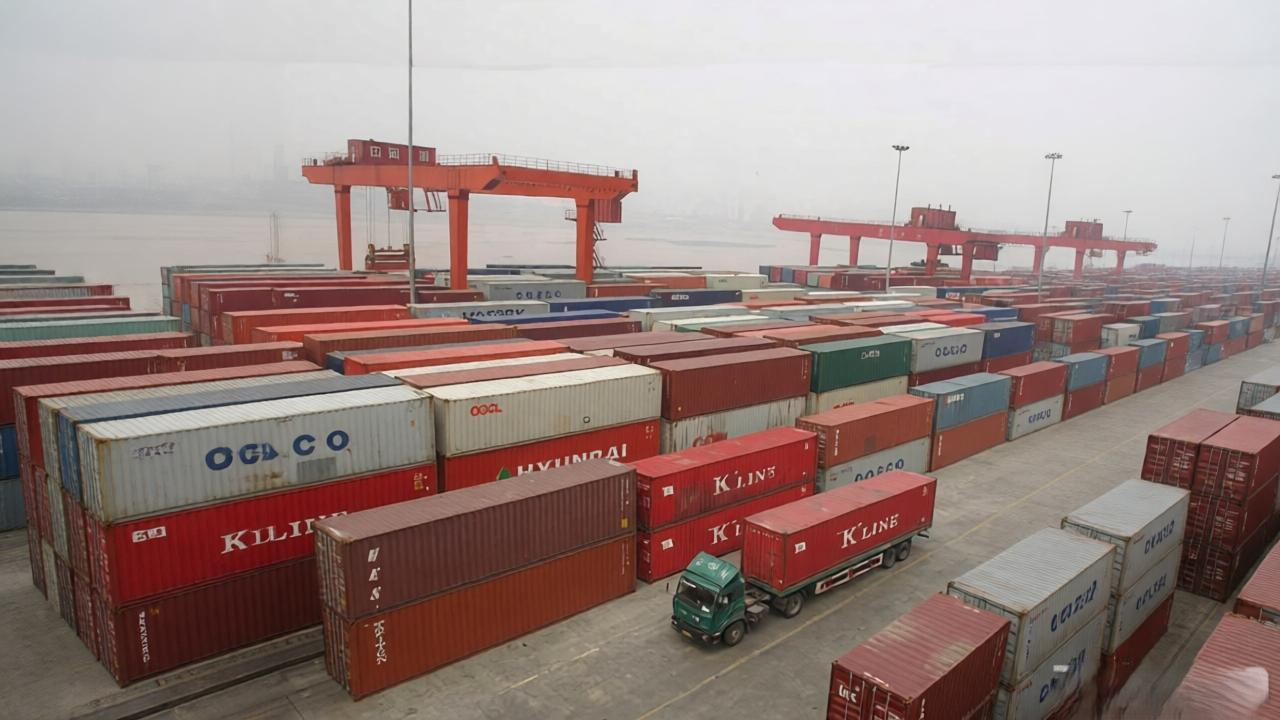
RMG and RTG have the same function. Both only stack containers and load/unload trucks in the yard; they cannot unload ships. The key differences are shown in the table below.
| Comparison | RMG | RTG |
| Walking style | Fixed ground rails, moving route is locked | Rubber tire driving, 90° free steering |
| Site flexibility | The work area must remain fixed and cannot be moved across container areas | Can move to different areas freely |
| Stacking effect | With ultra-precise positioning, containers are stacked tighter and higher | Positioning accuracy is slightly low. Large spacing between boxes wastes space. |
| Automation Ability | Upgraded to fully automated management | It can be modified, but it’s not precise, and the cost is higher. |
| Infrastructure costs | High cost, requires special track laying | Low cost, no need to lay tracks |
| Applicable Scene | High-density, high-efficiency storage yards require automation. | Ordinary storage yards and docks with frequently adjusted layouts |
How to Choose the Right Container Crane?
Choose an STS If:
- When you have a large container terminal or large ships.
- When you want to complete a handling operation quickly in a short period of time.
Choose an MHC If:
- Your terminal handles containers, bulk cargo, and general cargo;
- You own multiple berths but operate them infrequently.
Choose an RMG If:
- A more compact container stacking arrangement or higher storage capacity is required.
- Fully automated operations are needed.
- When you want containers stacked very high or to maximize land utilization.
Choose an RTG If:
- When the yard layout changes frequently, and you don’t want to spend money on laying tracks;
- When your budget is limited, or you don’t want to build complex infrastructure.
FAQ
What sizes of containers can a container crane lift?
Standard containers are available in 20GP, 40GP/40HC, and 45HC sizes.STS, MHC, RTG, and RMG spreaders can all handle these containers well with telescopic spreaders. For example, they automatically adapt to different container lengths. If you choose dual spreaders, you can also lift two 20GP containers simultaneously. If your container has special dimensions, you can configure a dedicated spreader for lifting.
What factors affect the service life of container cranes?
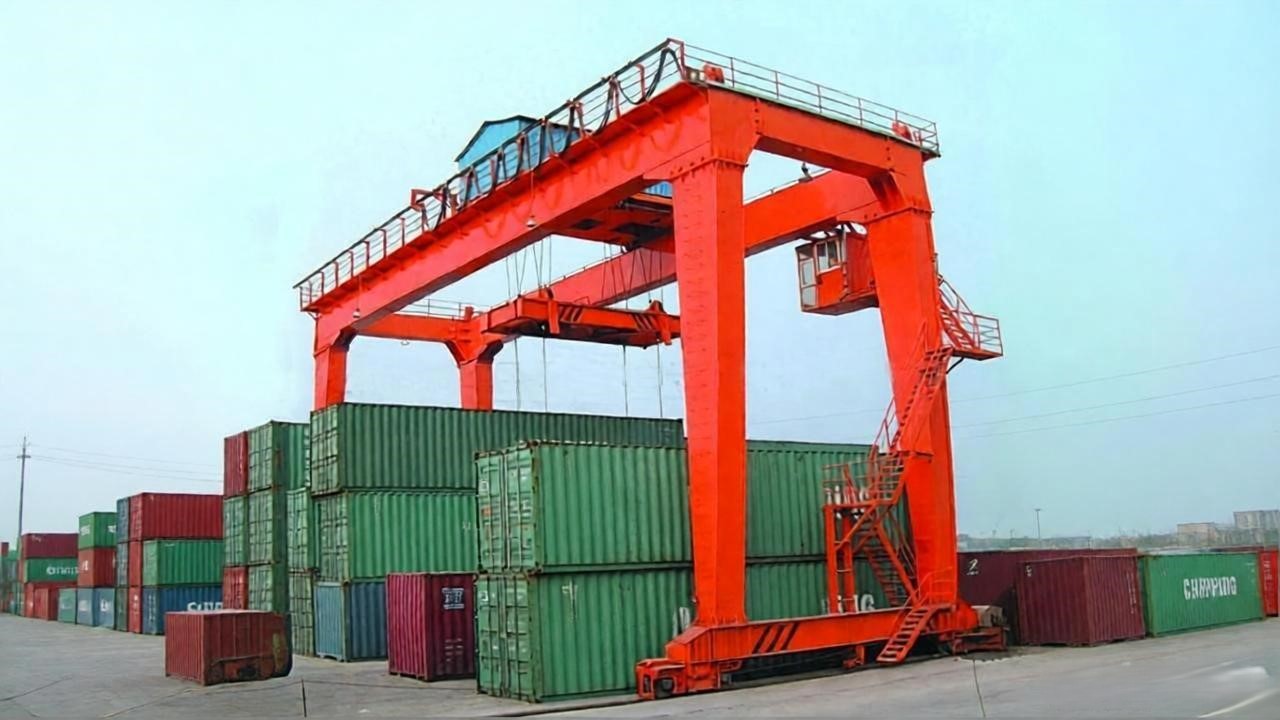
The normal service life of a crane is 20-30 years. Improper operation during use,
frequent overloading,reckless lifting,long-term overloading will shorten the crane’s lifespan.
Failure to perform regular inspections and maintenance during use, resulting in inadequate maintenance, will also shorten the crane’s lifespan. At the same time, we must not use inferior parts when replacing parts.
What safety devices are used on container cranes?
Many cranes are equipped with safety devices to prevent overloading, collisions, and accidents. These typically include overload limiters, collision avoidance systems, hoisting and trolley travel limit switches, and wind and storm protection devices. Spreader twistlocks are equipped with safety interlocks, emergency stop buttons, warning lights, and audible and visual alarms.
Can container cranes operate in windy conditions?
You can use it when the wind speed is low. However, you must stop operating it when the wind speed exceeds the critical value. Each piece of equipment will have the required operating conditions clearly marked before leaving the factory. For example, the maximum wind speed for STS and MHC operations is 65-72 km/h, and the maximum wind speed for RTG and RMG operations is 72-79 km/h.
How long does it take to install a container crane?
After the site infrastructure is set up:Under the condition of unfavorable environmental conditions:
Since the STS structure is the most complex, its installation time is the longest, requiring 8-12 weeks. The MHC can be installed and successfully commissioned in 3-5 weeks. On-site assembly and commissioning of the RMG requires 6-10 weeks. The RTG does not require track laying, so its installation time is only 4-6 weeks.
Reliable Container Crane Solutions From Dingya
Dingya cranes cover STS, MHC, RMG and RTG models for diverse port‑terminal demands. Built with robust anti‑corrosion steel and complete safety protections, they deliver steady, high‑efficiency container handling. Every unit supports custom dimensions to match your yard or berth conditions. Count on Dingya for reliable performance, reasonable costs and full after‑sales support for your port projects.