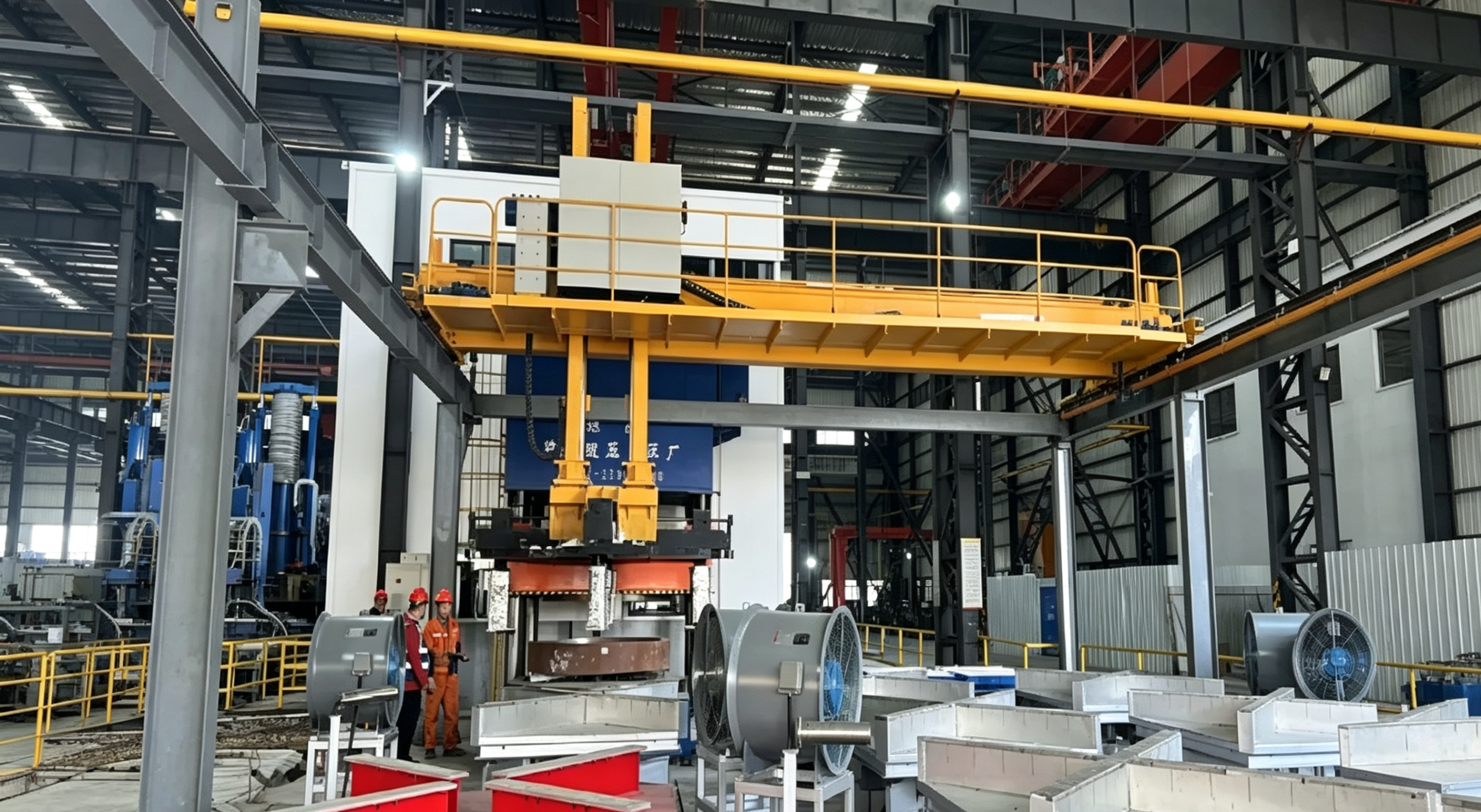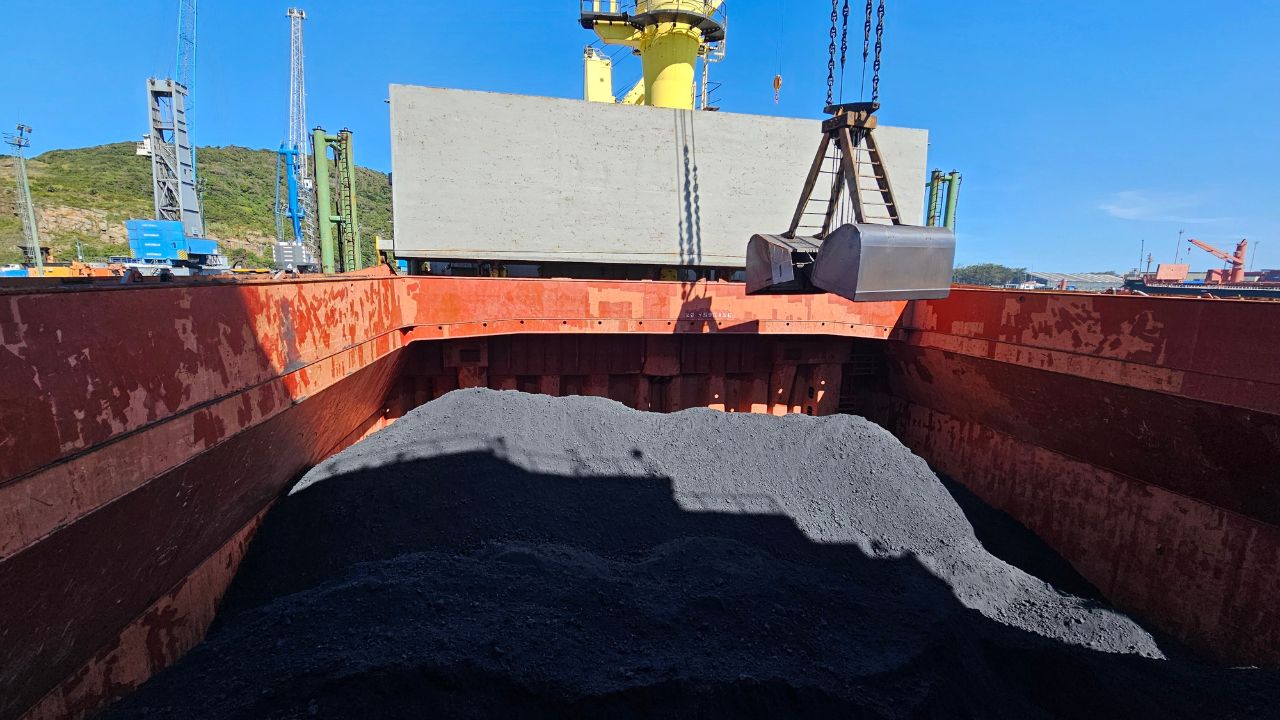
Do you realize that every factory has different conditions? For example, the factory environment, internal space size, production processes, and so on. In fact, no single crane is suitable for all working conditions. Therefore, today we will introduce the types of cranes commonly used in factories and how to choose the right crane for your factory.
What Types of Cranes Are Commonly Used in Factories?
Overhead crane
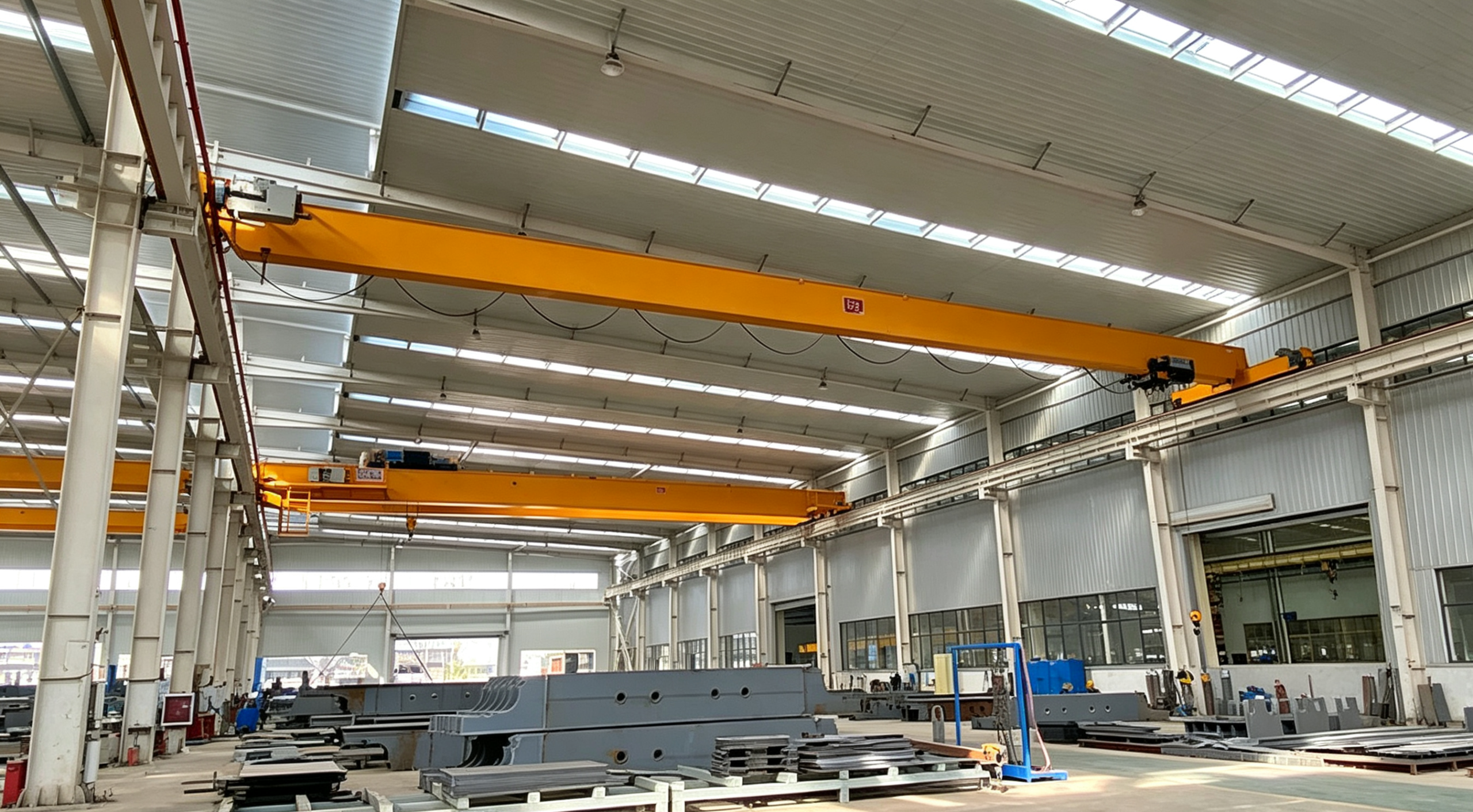
Single beam bridge crane
Single-girder bridge cranes are the most commonly used lifting equipment in indoor light industrial factories. Your factory doesn’t need to have ideal conditions. Even older factories can be equipped with single-girder bridge cranes. If your factory has a low ceiling, it’s also suitable. Because the clearance height of a single-girder bridge crane only needs to be greater than 4.2m.
The structure of a single girder is very simple. Generally, it can be divided into a main girder, end beams, track beams, electric hoist, and electrical control system. Only one main girder serves as the load-bearing beam for lifting your goods. Therefore, if you want to lift heavier objects, you must add another main girder. That’s a double-girder bridge crane.
Double beam eot crane
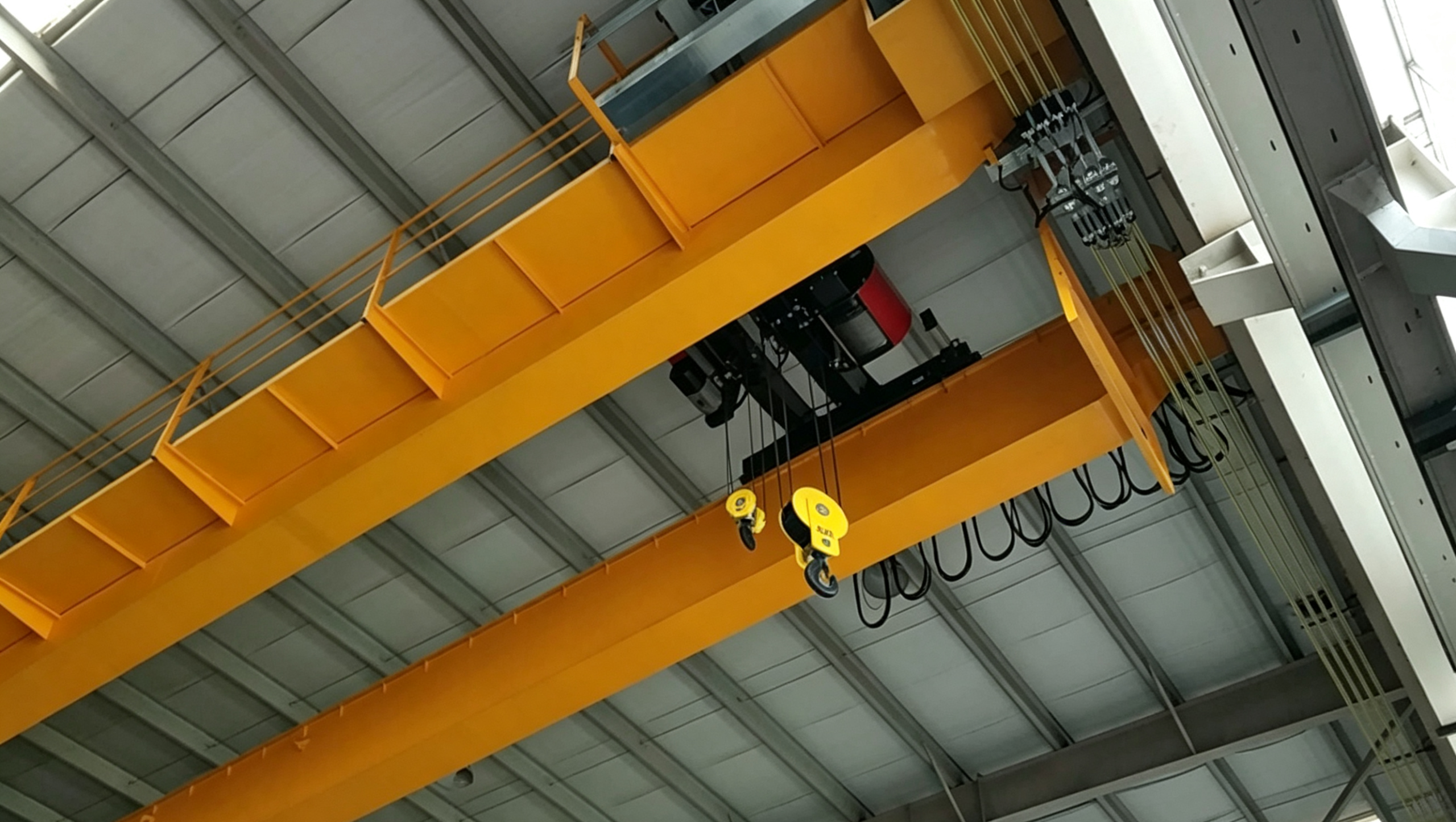
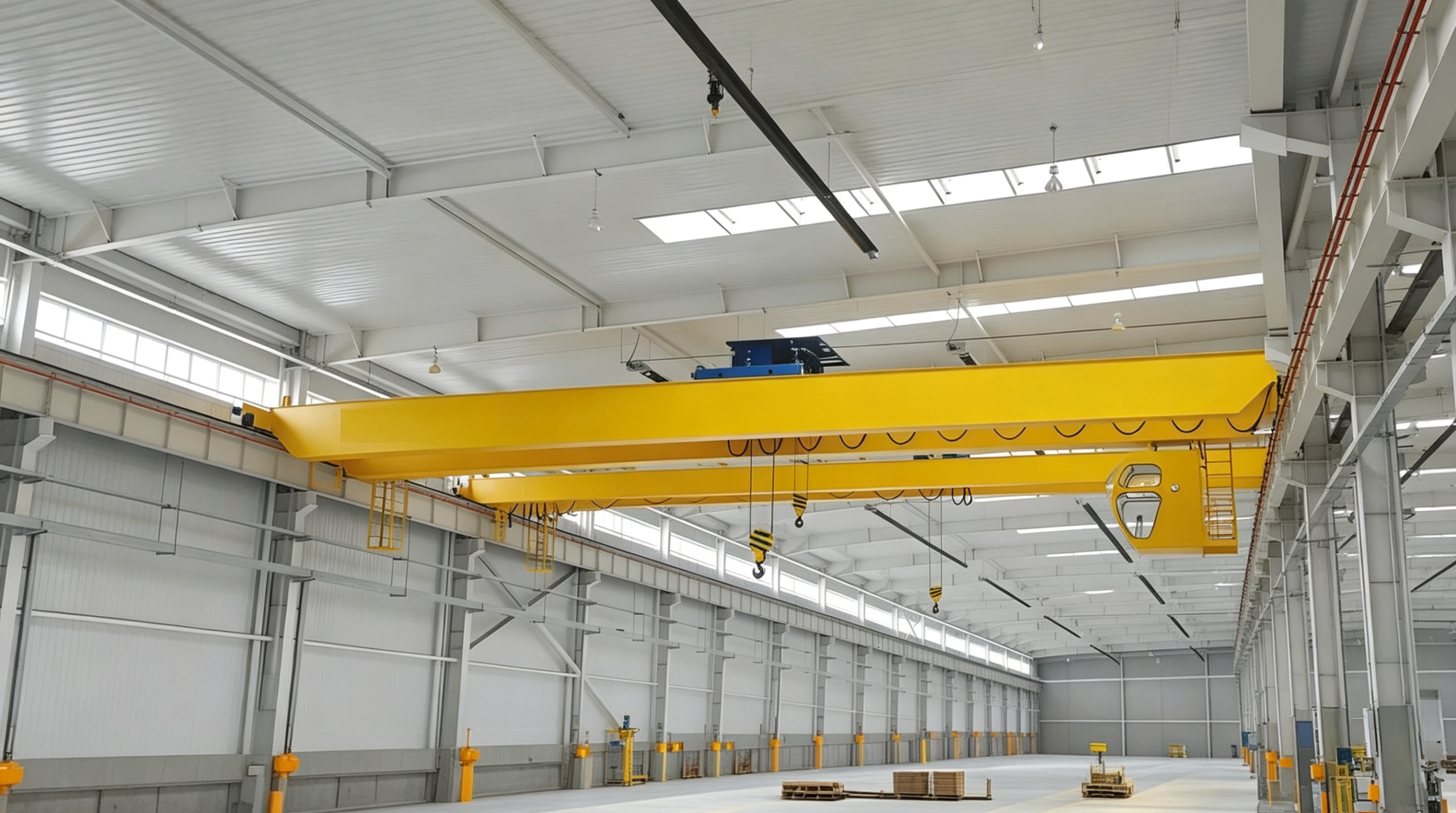
Double-girder bridge cranes are suitable for both light and heavy industry. If your factory span is greater than 10m, lifting height is greater than 6m, and factory conditions are good, you can use a double-girder structure for small-tonnage lifting. However, in terms of cost-effectiveness, it’s not as good as a single-girder bridge crane.
The same functional characteristics but twice the cost. It’s simply not worthwhile. Therefore, when you want to handle large-tonnage heavy objects that a single-girder crane cannot lift, we will prioritize double-girder bridge cranes. Due to their higher working level, they can perform lifting operations frequently and for extended periods. If you want to configure special lifting tools such as grab buckets and auxiliary hooks, you can also use double-girder bridge cranes.
Euro smart overhead crane
The Euro-Smart European-style fully automatic bridge crane is a popular new type of crane.It complies with FEM, EN, and ISO European crane standards. While featuring a lightweight crane structure, it incorporates a fully automatic intelligent electrical control system. It can automatically handle materials and provide precise positioning.
You can customize it to be either a single-beam or double-beam configuration to meet your needs. It’s ideal for factories with strict lifting operation standards. For example, factories requiring high lifting precision: precision equipment, new energy, automobile manufacturing, etc. All problems and reports encountered during operation will be transmitted back to the database. It’s also well-suited for modern automated production management.
If you don’t require high precision during lifting operations and have a limited budget. Don’t use this crane. This model is also unsuitable for factories with poor foundations or older factories that don’t require automation upgrades. It’s better suited for manual, traditional European-style cranes.
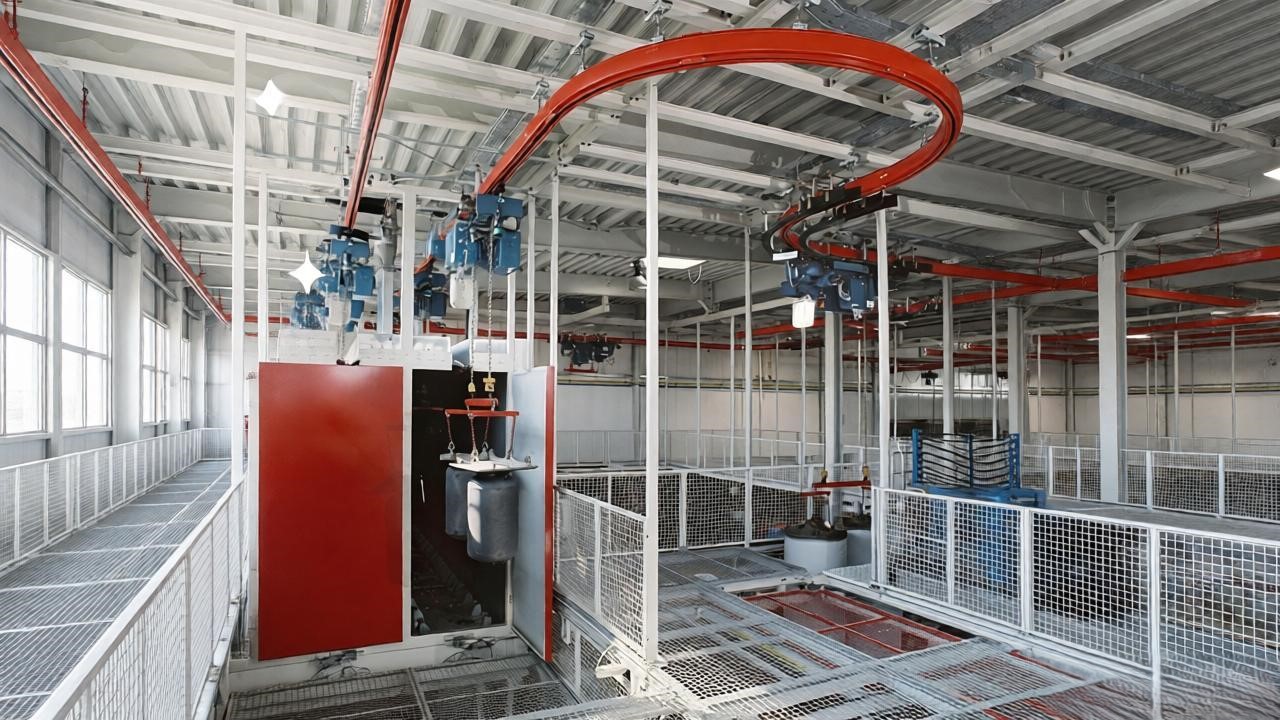
Monorail crane
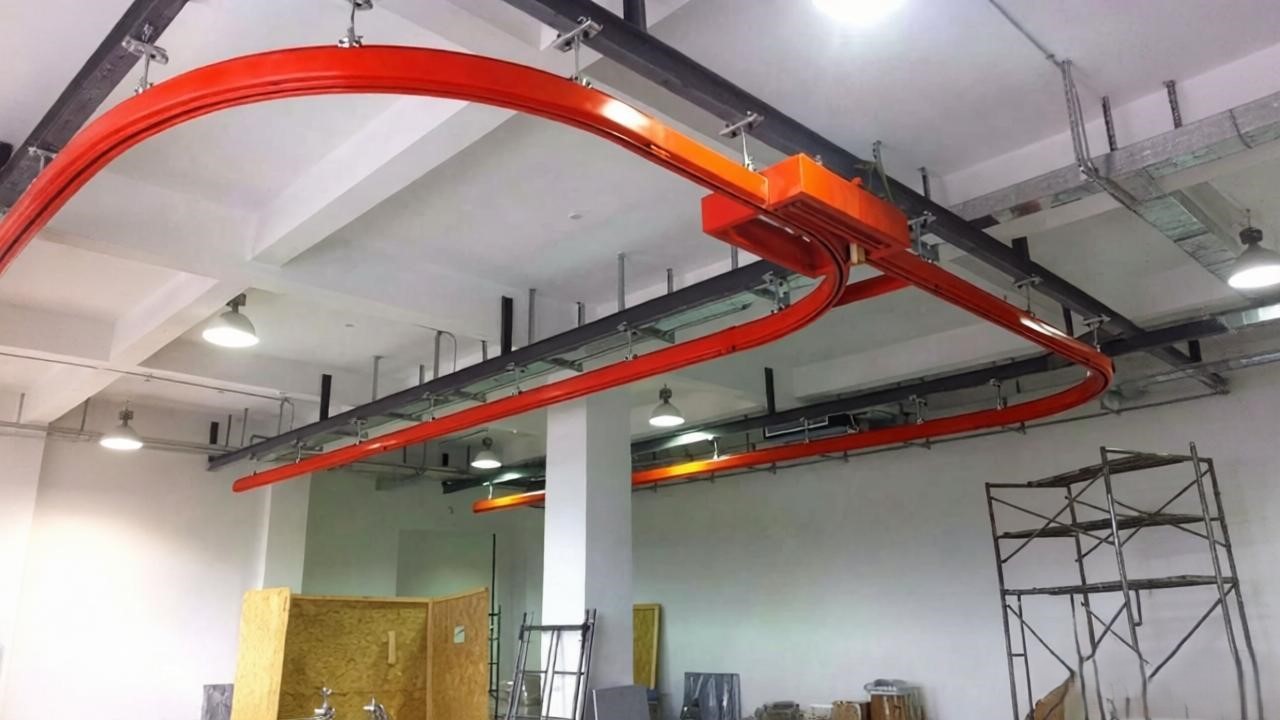
Monorail cranes don’t use H-beams to secure the rails. They use specialized monorails or I-beams. For those unfamiliar with I-beams and H-beams, please refer to the article “H-beams vs. I-beams“.The monorail is usually suspended under the steel beams of the factory building. The electric hoist moves along the rail to lift and load goods. The rail can be configured in straight lines, curves, or loops.
Gantry crane
Portable Gantry Crane
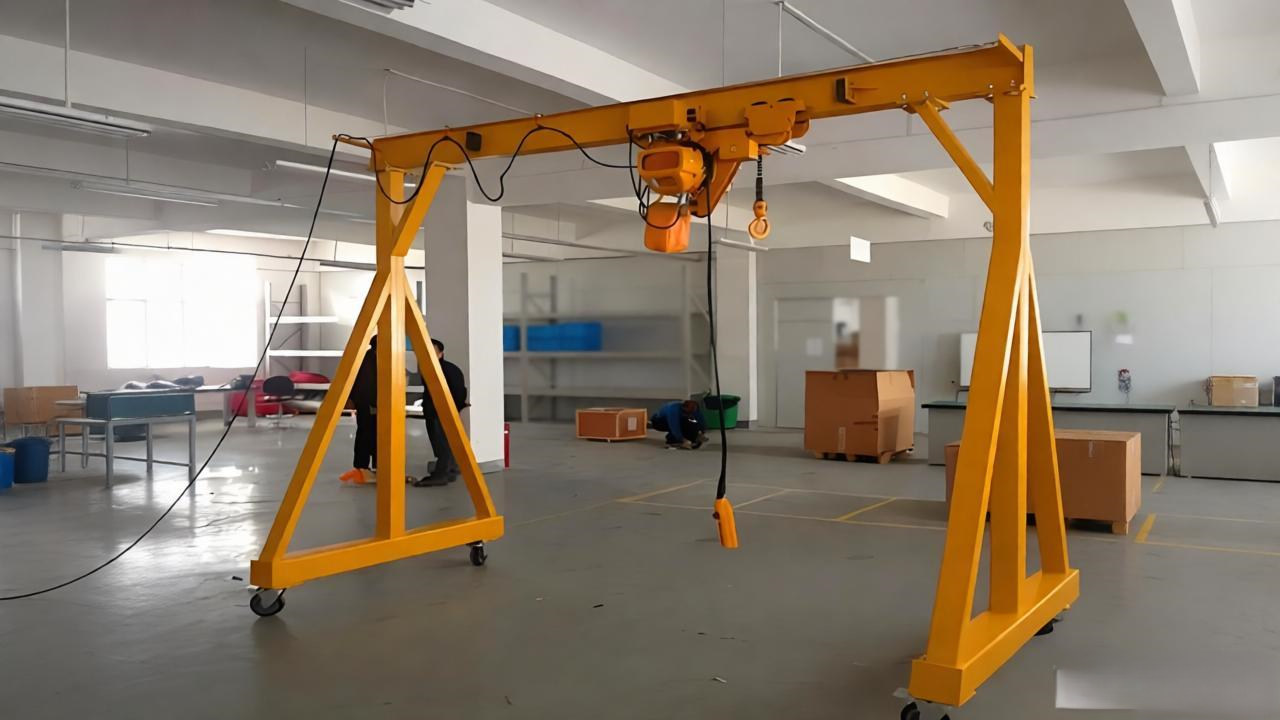
Portable gantry cranes are suitable for small, mobile gantry cranes used indoors.No specific factory layout is required. Only the weight of the goods to be lifted is a requirement. The lifting capacity is generally no more than 10 tons. The outriggers on both sides are height-adjustable. It can be moved manually or electrically. You can use it in different workshops and warehouses. Assembly and disassembly are simple. Perfect for those with a limited budget.
Rail-mounted Gantry Crane(RMG)
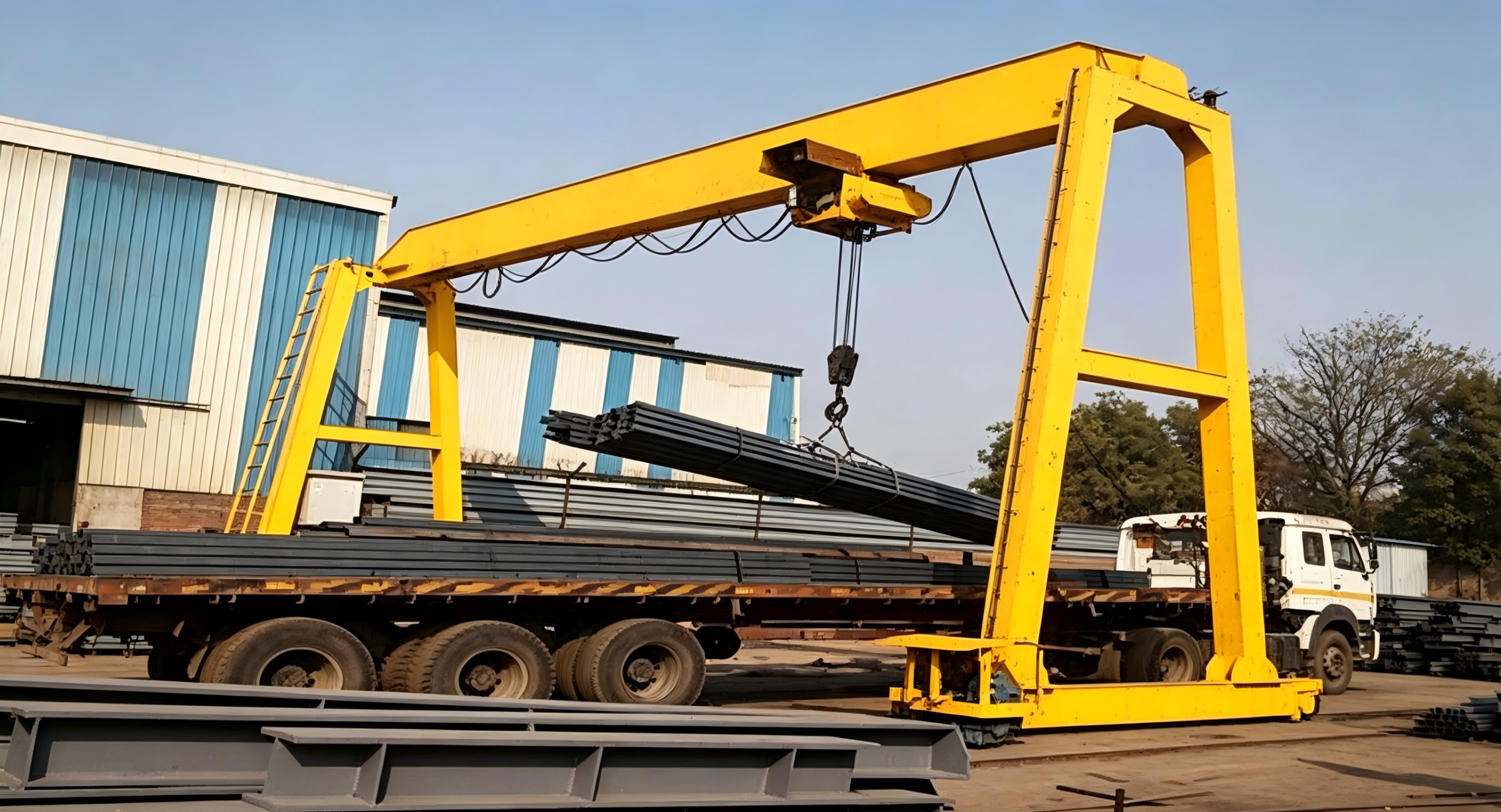
If your factory handling operations are not limited to indoors, you can use a rail-mounted gantry crane. It comes with outriggers and moves along rails you lay. The rails can be laid indoors or outdoors. The load-bearing capacity is entirely on the ground. The foundation requirements increase with the weight of the crane and the lifting capacity.
Rail-mounted gantry cranes cannot function without rails. They come in single-girder and double-girder structures. They are used to lift goods of varying tonnages. Double-girder rail-mounted gantry cranes are more commonly used outdoors. They can be used for rail freight, container freight, steel mills, and open-air storage yards. To move them across regions, rails must be laid in the designated area.
A rail-mounted gantry crane (RMG) is a heavy-duty outdoor gantry crane. The entire machine stands upright on two rigid outriggers. It travels along steel rails laid on a concrete foundation. Bridge cranes rely on the beams and columns of the factory building for support.
In contrast, the RMG is entirely supported by ground rails and the foundation. The lifting trolley moves laterally along the main beam to move heavy objects. The entire machine can only move in a straight line along the pre-set track. It is mostly used in open-air storage yards, rather than inside enclosed factory buildings. It can operate for extended periods.
Rubber-tyred Gantry Crane(RTG)
If you are in a port, logistics park, or prefabrication plant, etc., and need to handle cargo,
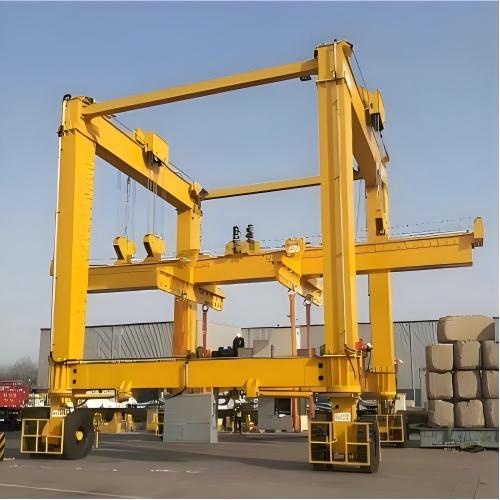
You can use a rubber-tired gantry crane (RTG), which is used outdoors. It is not supported by outriggers, but by rubber tires, and does not require steel rails. The rubber tires allow for free movement and turning. It can move across areas. Ideal for scenarios where digging and laying rails is not feasible.
A rubber-tired gantry crane is an outdoor mobile gantry crane. It moves using heavy-duty rubber tires and does not require steel rails. Compare this to a rail-mounted gantry crane, which is restricted by rails. The RTG can move freely on paved ground. Including 90° turns and lateral movement. The entire machine can be driven directly to different stacking areas.No new rails are needed. It is widely used in container yards, logistics parks, and prefabrication yards. To complete cargo stacking, loading, unloading, and transfer.
Jib crane
Column-Mounted Jib Crane
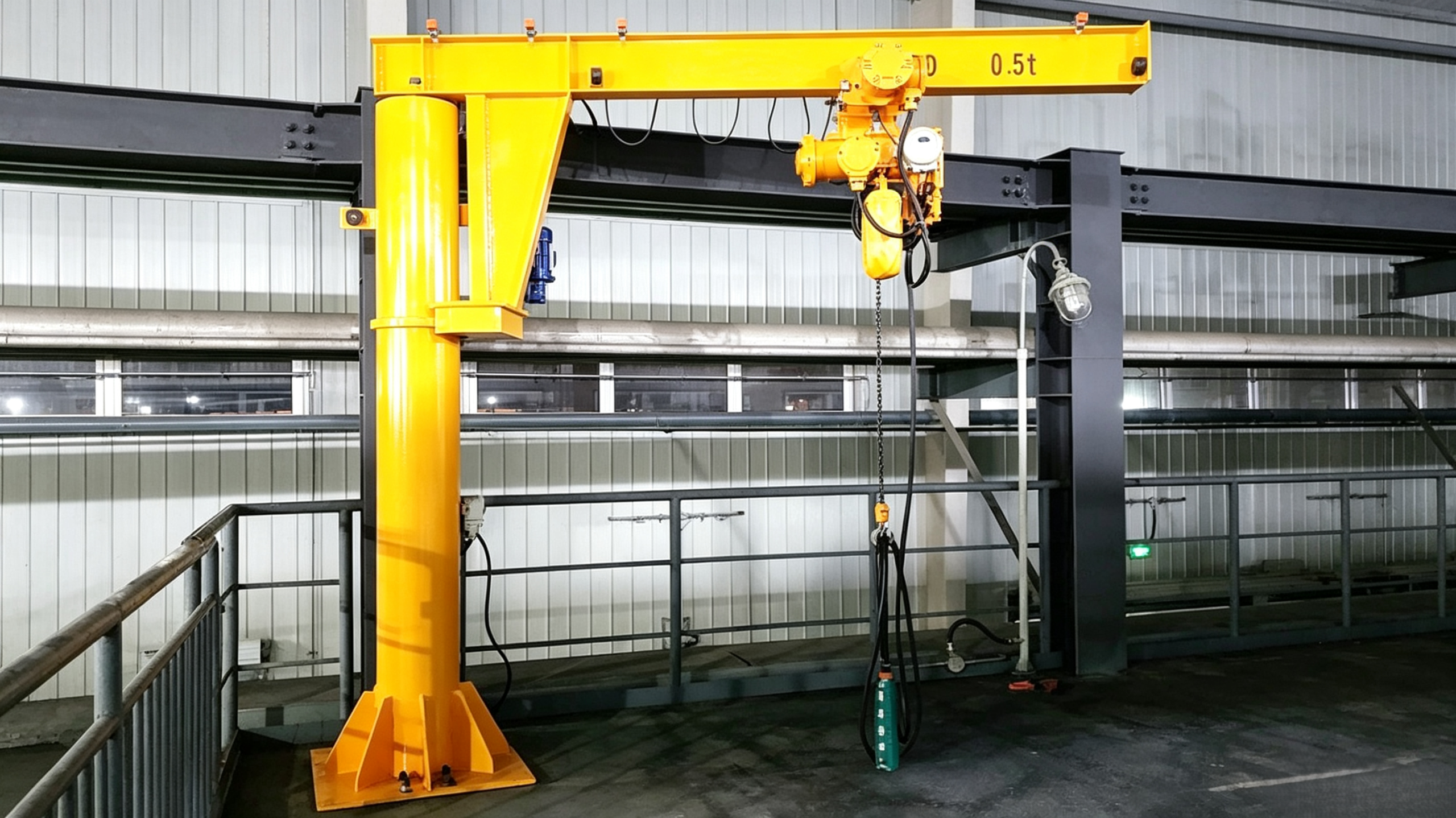
The Column-Mounted Jib Crane does not require support from steel beams or walls in your factory building. It only needs its own column fixed to the ground and can rotate 360 degrees within a certain range for lifting, and has a relatively small footprint. It can be used within your factory premises.
The horizontal boom can be used with wire rope hoists and chain hoists to repeatedly lift within a certain working range. When you only need to lift goods within a small area and your budget does not allow for the purchase of bridge cranes or gantry cranes, the Column-Mounted Jib Crane is a good option.
Mobile Jib Crane
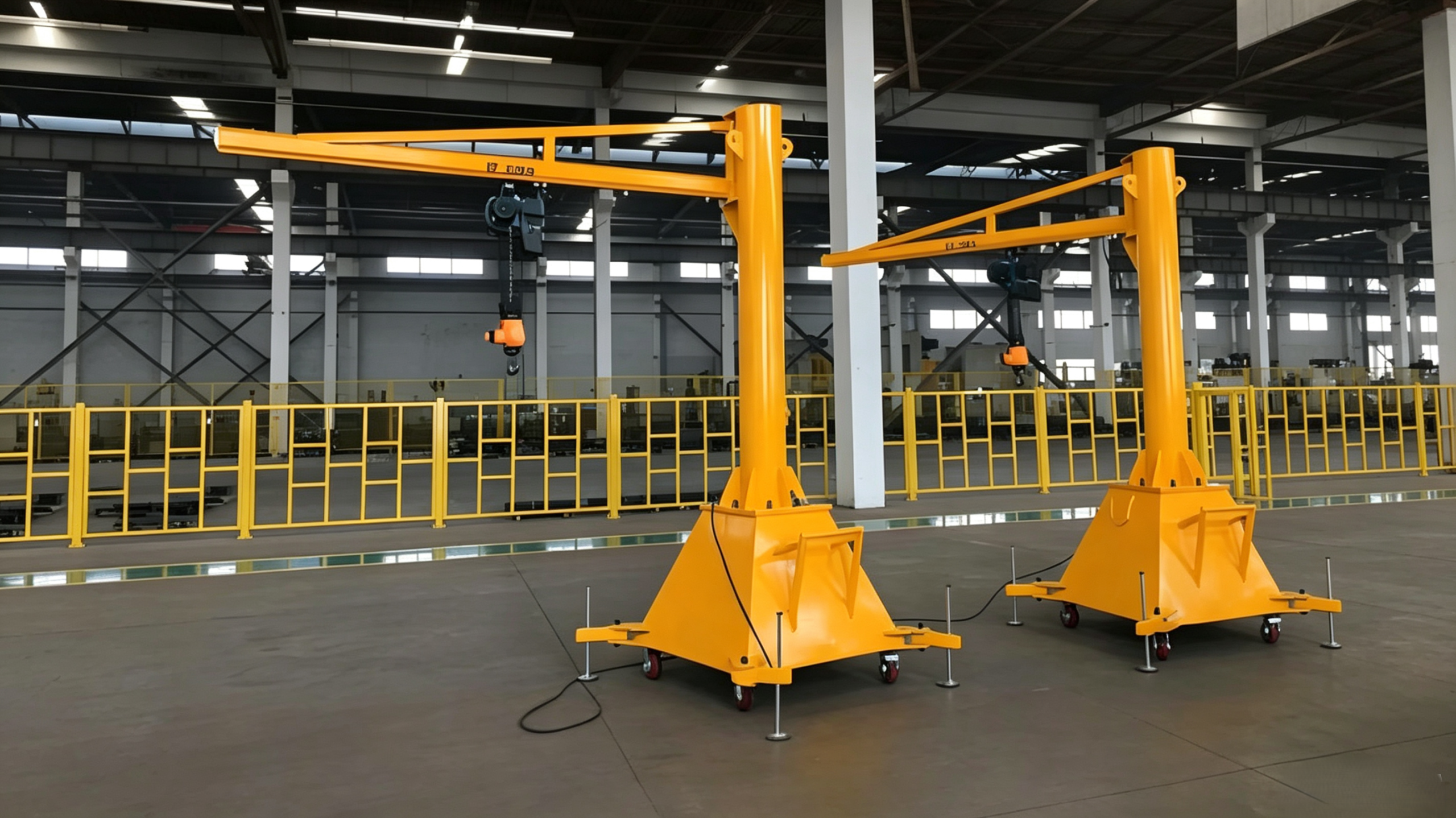
The mobile jib crane has wheels at the bottom. It can move across areas, but manual pushing is required. The lifting of the hook on the horizontal boom can be controlled via remote control. The larger the tonnage, the longer the horizontal boom.
It can lift materials from 0.25-5 tons due to its high mobility. Therefore, it is not limited to inside or outside the factory area. However, the caster brakes must be locked before lifting.
Never lift anything while the crane is moving.
Wall-Mounted Jib Crane
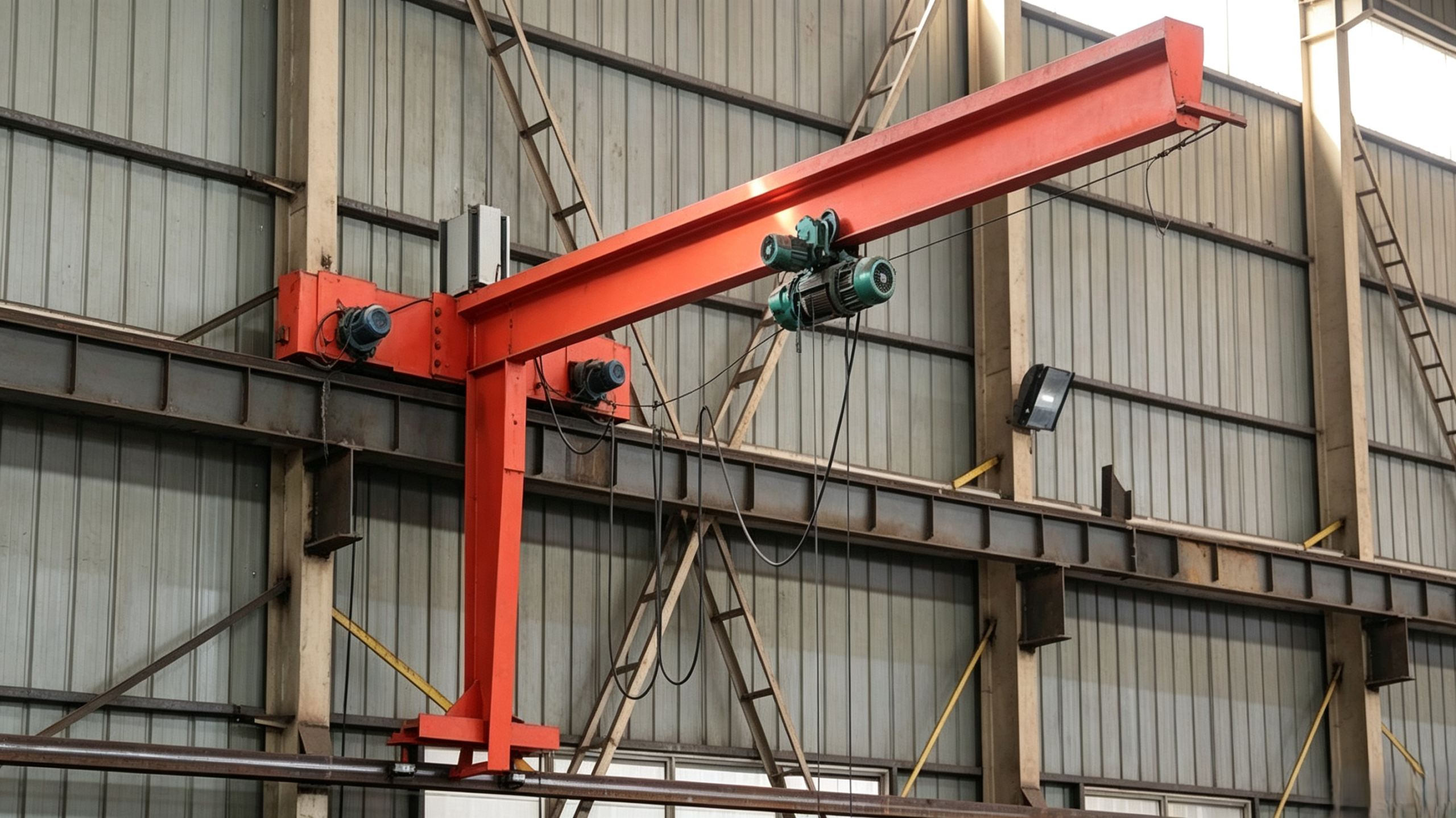
Wall-mounted jib cranes need to be fixed to walls or structural columns within the factory area. This saves floor space. They are only suitable for small-scale material handling within a 180-degree radius.
The load-bearing capacity is relatively small, ranging from 0.25 t to 5 t. They cannot be used outdoors. Indoors, to ensure stability, bolts need to be welded or high-strength anchors used for fixing to the wall. They are ideal for small processing plants.
How to Choose the Right Crane for Your Factory
| Crane Type | Typical Capacity | Factory building requirements | BestFit Scenarios |
| Single girder overhead crane | 0.5-20t | Track beams need to be configured | Standard indoor material handling throughout the workshop |
| Double girder overhead crane | 5-100t+ | Heavy-duty steel beams for factory rails | Heavy-duty, high-cycle workshop production |
| Euro smart overhead crane | 150t | Track beams need to be configured | Precision, low-noise modern factory |
| Monorail crane | 0.25-10t | Rooftop equipped with suspended track beams | Assembly line material transfer |
| Portable gantry crane | 0.5-10t | flat and solid concrete floor | Indoor temporary intermittent hoisting |
| Rail-mounted gantry crane (RMG) | 5-100t+ | Reinforced concrete foundation + steel rails | High-frequency outdoor operations |
| Rubber-tyred gantry crane (RTG) | 5-100t | Hardened ground | Flexible outdoor cargo transfer |
| Column-mounted jib crane | 0.25-10t | Requires an independent reinforced concrete foundation | Fixed workstation, hoisting in 360-degree directions within a defined work area. |
| Wall-mounted jib crane | 0.2-5t | Requires load-bearing walls / steel columns | Wall-mounted workstations save floor space and allow for 180-degree hoisting within a small area. |
| Mobile jib crane | 0.2-5t | Indoor concrete floor | Cross-regional mobile hoisting |
FAQ
What Safety Devices Are Commonly Installed on Factory Cranes?
Cranes typically come standard with overload limiters, lifting limits, safety electrical equipment, and buffers. If you are using a jib crane, it may be equipped with a slewing limiter. If you use an outdoor gantry crane, it will be equipped with an anemometer and windproof anchors. These are used to prevent overloading, collisions, and falling objects.
How Can You Reduce Factory Crane Downtime?
You need to conduct regular inspections as recommended by the manufacturer. Manage your operating environment effectively. This helps you identify potential problems early. If a problem does occur, you can quickly complete repairs. Additionally, practice 5S daily organization. Daily small checks help you identify potential problems early. Preventing them from escalating into costly downtime.
Can multiple types of cranes be installed in the factory?
Yes, if your factory has excellent conditions and requires multiple lifting methods, such as using a bridge crane for lifting heavy objects at height, and also needs to handle small-scale, high-intensity moving of things, you can choose to install a cantilever crane or a mobile gantry crane, without needing to make it too high.
What Accessories Can Be Added to a Factory Crane?
You can add accessories to your crane according to your budget.These include wireless remote controls, audible and visual alarms, load indicators, collision avoidance devices, etc.
For special working conditions, grab buckets, explosion-proof kits, etc., can also be added. For specific details, you should consult the crane manufacturer to inquire about which accessories are required.
What Is the Difference Between a Manual and Automated Factory Crane?
Manual cranes move with your remote control.You manually control each movement.
Automatic cranes often require no human intervention throughout the entire process.
They automatically position themselves and can operate unattended.Before selecting a crane, you need to choose the appropriate model based on your budget, work frequency, and labor costs.
Get Custom Crane Selection Support From Dingya Crane
Dingya Cranes manufactures bridge cranes, gantry cranes, and jib cranes, suitable for various indoor and outdoor working conditions. We analyze your lifting weight, operating area, factory restrictions, and relocation needs. Select the ideal model. CE-certified, robust equipment reduces downtime and maintenance costs. Get direct access to Dingya’s factory for professional consultation, customized drawings, and comprehensive after-sales service.