In most cases, Dingya crane experts offer free consultations and guidance on choosing the best cranes for free. Whether you are operating a foundry shop, small workshop, shipping container terminal or automotive industry, here are 5 important points to consider when choosing a crane for any project:
Specify Core Lifting Mechanics
It is important to specify the rated capacity (load), focusing on the heaviest load the crane will lift. Of course, it is also important to include the weight of any other accessories that may include spreader beams, slings or shackles.
In addition to these, it is advisable to determine the lift stroke or vertical height which includes the height of the object, rigging length and obstacle. Not forgetting the horizontal coverage or span.
Determine Duty Class
Always match the crane with the intended operation requirements. For example, a crane that lifts 20 tons a day will have a different structure from a crane that lifts 20 tons 10 times an hour.
Among the most common classifications are CMAA Class A-B/FEM1Bm where the crane is engineered for light duty in standby facilities or maintenance shops.
There is also the CMAA Class C-D/FEM 2m – 3m that are generally a heavy to moderate duty applications. They are suitable for warehouses or machine shops that operate between 50% and 100% of their full capacity.
Lastly, there is the CMAA E-F/FEM 4m – 5m, which are continuous duty cranes for severe or continuous-duty applications.
Remember, a mismatch in crane classes will cause premature structural cracking, gear wear or rope fatigue. That is why, as an industrial crane manufacturer in China, we offer free guidance on choosing the right lifting equipment.
Focus on the Crane Architecture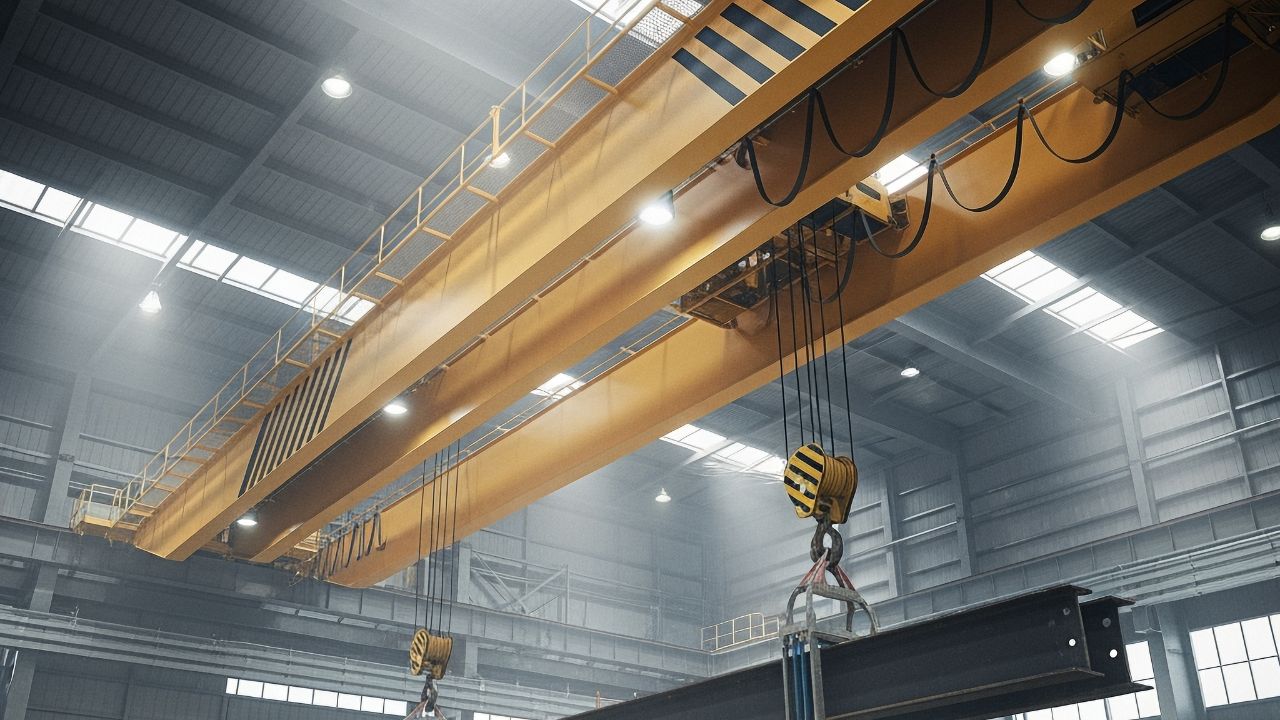
This is where the main focus is on the physical design of the crane type and existing constraints. Let’s evaluate some of the common types of cranes:
| Type of Crane | Recommended Applications and Benefits |
| Overhead bridge crane | · They are most supported by building supports that offer high-capacity lifting. · These cranes clear ground-level for other operations like using forklifts. · Working with a reputable overhead crane manufacturer will help determine the right specifications. |
| Semi/full gantry cranes | · Most gantry crane manufacturers recommend them for outdoor storage yards, rented facilities, and ports · They don’t require overhead building runways |
| Jin crane | · Offers flexibility with individual assembly workstations · They offer 180 to 360 rotation, making them suitable for high-frequency lifting whenever there are space constraints |
Consider Environmental Factors
The physical location determines the crane design. For example, for outdoor operations, the crane requires an IP 55 of IP65 electrical enclosure. At the same time, for port operations, the crane should have a marine-grade epoxy coating.
In hazardous environments, the crane should have an explosion-proof design and in extreme temperatures, they require specialized lubricants and thermal protection.
Consider Technology and Smart Safety
Many industrial cranes from China feature smart technologies to enhance operation and safety. For instance, they have overload limiters, remote control systems, predictive maintenance systems, and electronic anti-swat systems.
All these intelligent features improve energy efficiency while enhancing crane machine safety.