Once you have installed an overhead crane in your workshop, it is essential not to overlook its inspection. Overhead crane inspections can detect minor faults and prevent them from escalating into serious hazards, thereby safeguarding both your workshop’s assets and personnel safety. If you are unsure how to conduct these inspections, please continue reading the article below for some reference solutions.
Methods of Overhead Crane Inspection
Inspection schedule
Initial inspection:
Before an overhead crane is put into service, it must undergo an initial inspection by trained operators, and only after obtaining the compliance may it be operated. Please note that if your existing crane is relocated or modified, a new initial inspection must be arranged.
Frequent inspection:
Depending on the operating conditions of your workshop (the frequency of use of the bridge crane, the frequency of full loads, etc.), it is necessary to conduct frequent inspections of the bridge crane. The frequency of inspections can vary from daily to weekly to monthly. You can refer to the table below to determine the appropriate inspection frequency for your specific bridge crane.
| Working duty CMAA | Working duty FEM | Working duty ISO | Working condition | Inspection frequency |
| Class A | 1Cm / 1Bm | M3 | Normal | Semi-Monthly to Monthly |
| Class B | 1Bm | M3 | ||
| Class C | 1Am | M4 | ||
| Class D | 2m / 3m | M5 / M6 | Heavy | Weekly to Monthly |
| Class E | 3m / 4m | M6 / M7 | Severe | Daily to Weekly |
| Class F | 4m / 5m | M7 / M8 |
Periodic inspection:
Periodic inspection refers to the examination of various components of a crane. The frequency of inspections also needs to be determined based on your usage frequency and load capacity. Please refer to the table below.
| Working duty CMAA | Working duty FEM | Working duty ISO | Working condition | Inspection frequency |
| Class A | 1Cm / 1Bm | M3 | Normal | Annually |
| Class B | 1Bm | M3 | ||
| Class C | 1Am | M4 | ||
| Class D | 2m / 3m | M5 / M6 | Heavy | Semi-Annually to Annually |
| Class E | 3m / 4m | M6 / M7 | Severe | Quarterly |
| Class F | 4m / 5m | M7 / M8 |
What items need to be inspected for cranes in operation?
① Wire rope
The wire rope is the part most prone to wear and failure, and when it fails, the consequences can be severe. Therefore, it requires regular attention. According to ISO 4309:2017, if your wire rope exhibits any of the following conditions, it must be immediately shut down:
- The number of broken strands within a given length of the twist interval exceeds the standard threshold for scrapping (the specific value is determined based on the rope’s type and the crane’s operating class M1-M8).
- The diameter of the rope has decreased by more than 10% from its nominal diameter. In practice, measure at three points along the rope and take the average — wear is rarely uniform.
- Visible signs of corrosion, deformation, twisting, cage-like distortions, or severe wear.
- The core of the rope is exposed, or the entire strand has broken.
② Hook
The hook is a high-priority item for direct load handling, and its inspection is critical. The following conditions require immediate scrapping:
-The opening size of the hook has increased by more than 15% over its original dimensions (OSHA 1910.179). Measure this at the narrowest point of the throat using a caliper.
- The wear on any cross-section of the hook exceeds 10% of its original dimensions.
- The hook body undergoes a twisting deformation exceeding 10°.
- Any visible cracks have appeared.
- The safety latch is damaged or no longer functional.
③ Brake
The brake is a primary safety device of a crane; in the event of an accident, it must ensure the crane can stop immediately. Therefore, its performance must be verified as fully functional:
- Confirm that the crane’s torque meets rated requirements;
- Inspect the wear condition of the brake lining;
- Assess the smoothness of brake actuation, checking for any sticking or delay, and ensure all springs, pins, and linkages are intact.
A simple field test: lift a rated load a few centimeters off the ground and hold it for 5 minutes. If the load drifts down, the brake needs adjustment.
④Limit switch
The crane’s limit switches include the hoisting limit, the bridge travel limit, and the trolley travel limit. Please note that you must test each of these limits individually to ensure they function properly.
If any limit switch fails, your crane faces a high risk of over-winding or striking the top stop, creating a serious safety hazard. Testing should first be conducted under no-load conditions, followed by light-load testing—some switches may behave differently when subjected to load.
⑤ Electrical System
- Power supply cables and connectors: check for wear, aging, or exposed conductors
- Control system: verify push buttons and contactors actuate without sticking
- Discharge and odor: look for any arcing marks or burnt smell
- Grounding: confirm continuity between crane frame and earth
A quick visual check of cable entry points often reveals chafing or insulation damage before it becomes a fault.
⑥ Crane travelling mechanism
The crane’s travelling mechanism comprises both the bridge travel and the trolley travel. Inspection must ensure that these movements occur without unusual noise, vibration, or deviation from the intended path. It is also necessary to examine the wear condition of the wheels and any impact at the rail joints, as well as verify that the lubricant level in the reducer is within the normal range. Listen for irregular clicking during travel — it often indicates a flat spot on a wheel or a loose rail joint.
⑦ Metal structure
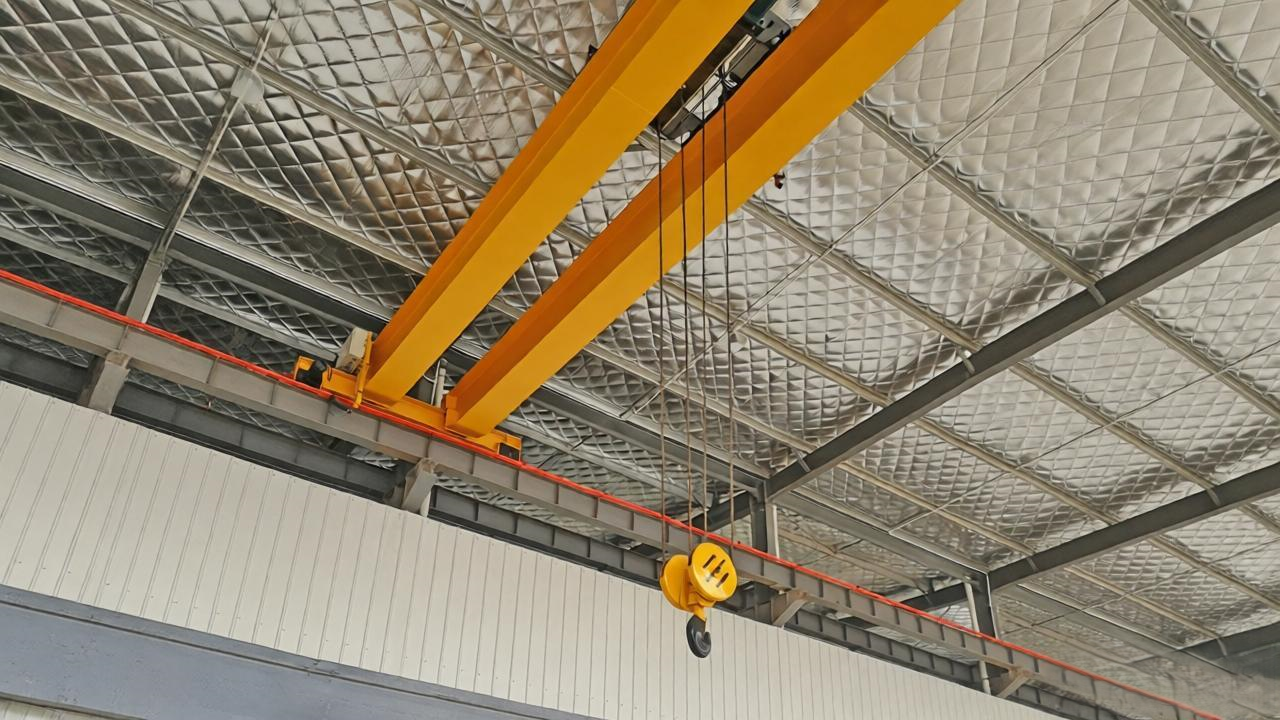
Inspection of metal structures is primarily conducted visually to check the main girders and end beams for obvious bending, cracks, or weld failures; additionally, the deflection of the bottom cover plate is measured to ensure it remains within normal limits. For a quick reference, mark the deflection point with a chalk line and compare it against the crane’s original factory test report.
What items need to be inspected for idle cranes?
Recommended inspection intervals for idle cranes:
| Idle Duration | Inspection Required |
| Up to 1 month | Follow Initial Inspection standards. Pay extra attention to lubrication condition and brake response. |
| 1 – 6 months | Follow Initial Inspection items, plus: check wire rope for local deformation or corrosion from prolonged stationary state; verify electrical insulation resistance; re-lubricate all points; manually release and test brake operation. |
| Over 6 months | Conduct a full Periodic Inspection by qualified personnel. A valid inspection report must be issued before the crane is returned to service. |
Records and Follow-up After Inspection
After the inspection is completed, please ensure that you retain written records containing the following: the inspection date, the name and qualifications of the inspector, a detailed list of inspected items, any issues identified along with their resolution, and the recommended date for the next inspection.
Different regional standards impose slightly varying classifications and requirements for bridge crane inspections; however, all local regulations mandate such inspections, forming the foundation of your crane’s full lifecycle management. If an inspection reveals issues, they must be categorized based on severity into either immediate shutdown and rectification or “monitored operation with scheduled maintenance, and the crane must never be operated while defective. Inspection records also serve as a critical basis for defining responsibilities between suppliers and your organization; it is recommended to retain these records for at least five years.
FAQ
How often should an overhead crane be inspected?
Inspection frequency depends on usage intensity and local regulations. Generally, an initial inspection is required before each shift, with frequent daily or monthly checks, and periodic inspections conducted by qualified personnel every 1 to 12 months. In cases of high-intensity use or harsh environments, the inspection frequency should be appropriately increased.
Can I perform crane inspections myself, or do I need to hire a third party?
Initial and frequent inspections can be performed by trained in-house operators. However, periodic inspections must be conducted by a qualified third-party inspector or a certified competent person, as most local regulations require an independent assessment for legal compliance. Check your local rules — in some countries, the inspector must hold a specific license issued by the regulatory authority.
What happens if an overhead crane is not inspected regularly?
Failure to conduct regular inspections not only increases the risk of equipment malfunctions and safety incidents but also exposes individuals and organizations to legal penalties in most countries. For example, Brazil’s NR-12 regulations stipulate that companies found in violation may be ordered to cease operations, while Malaysia’s DOSH regulations impose a maximum fine of RM100,000 for operating a crane without a valid and applicable certificate.
Does an explosion-proof crane require a different inspection process?
Yes. In addition to the standard inspection items for explosion-proof cranes, there are additional checks required, such as verifying the validity of the ATEX explosion-proof certification, ensuring the integrity of the explosion-proof electrical components, and confirming that the Zone classification of the area where the equipment is located matches the explosion-proof rating of the crane.
What is the difference between frequent inspection and periodic inspection?
Frequent inspections are primarily visual, characterized by high frequency and short duration, and are carried out by operators or maintenance personnel. Periodic inspections cover a broader scope, require personnel with professional qualifications, and involve the issuance of formal reports; they serve as a key basis for regulatory compliance.
Can an overhead crane be used if it fails an inspection?
No. Once an inspection reveals defects that compromise safety, the equipment must be immediately taken out of service and rectified. It may only resume operation after successful re-inspection. Operating with known defects is not only hazardous but also exposes the responsible parties to legal liability.
How long should crane inspection records be kept?
It is recommended to keep them for at least 5 years. Some national regulations have specific requirements; for example, the European Machinery Directive requires relevant technical documents to be kept for 10 years. Complete inspection records are also an essential basis for handling accidents, disputes, and insurance claims.
Looking for an Overhead Crane That Meets Your Local Standards
At DINGYA, we manufacture overhead cranes that comply with European EN standards and carry CE certification — so your equipment arrives ready for inspection, not just ready for use. With years of experience supplying clients across the whole world, we understand that compliance requirements vary by region. Our engineer can help you select the right crane for your operating environment and provide the technical documentation you need for local certification. Contact us today to discuss your requirements!