Choose a false type of gantry crane, maybe lose a lot of money. You may keep needing to repair it or unable to lift your goods, even make your business die. Today, this article will tell you what type of gantry crane and how to choose the right gantry crane.
Types Of Gantry Cranes
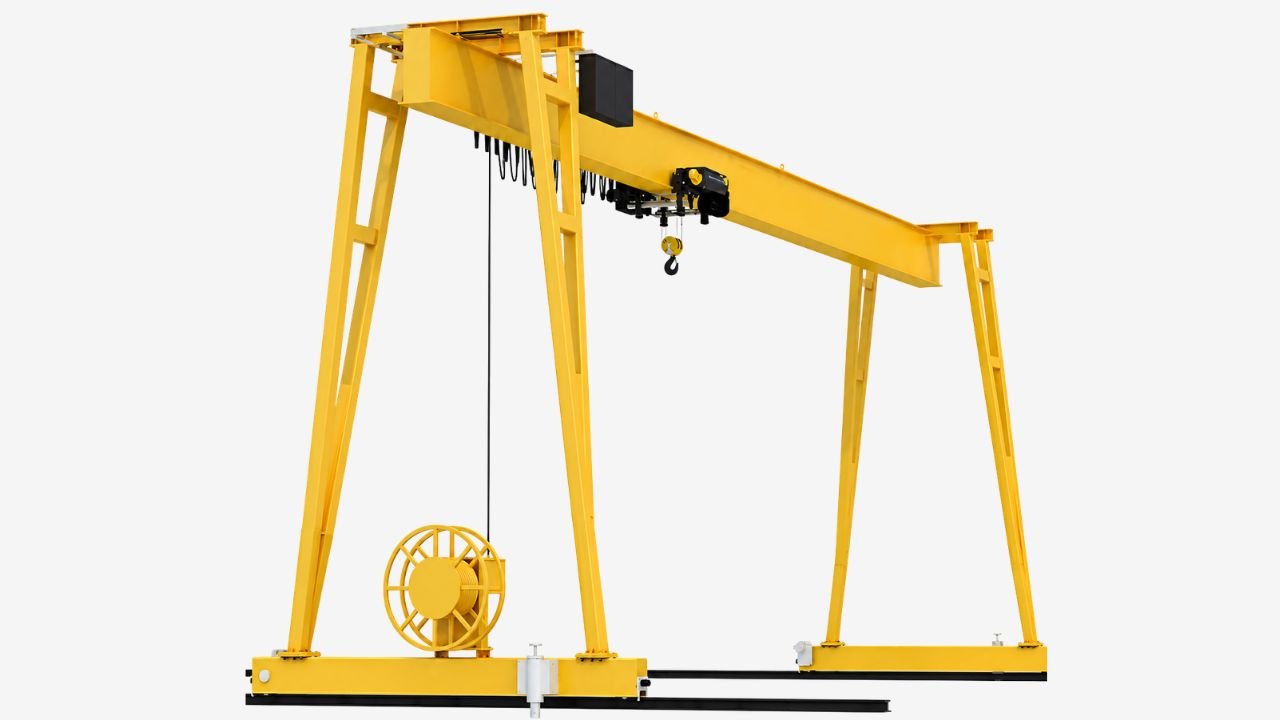
1. Single-Beam Gantry Crane
Composition Structure
The structural composition of a single-girder gantry crane consists of a single main girder, dual side legs, a traveling mechanism, an electric control system, and a suspended electric hoist. It features only one load-bearing main girder, with both ends supported by rigid side legs. It is not suitable for hazardous environments.
Advantages
You save money with a lightweight design to reduce manufacturing costs, minimize maintenance, shorten the payback period, and require no complex installation.
Typical Application
Suitable for owners of small and medium-sized lifting equipment factories, with the largest purchase volume from factories in Southeast Asia and the Middle East.
Lifting range
1 t – 20 t, with very few units exceeding 32 t;
Span typically ranges from 6 m to 30 m.
2. Double-Girder Gantry Crane
Composition Structure
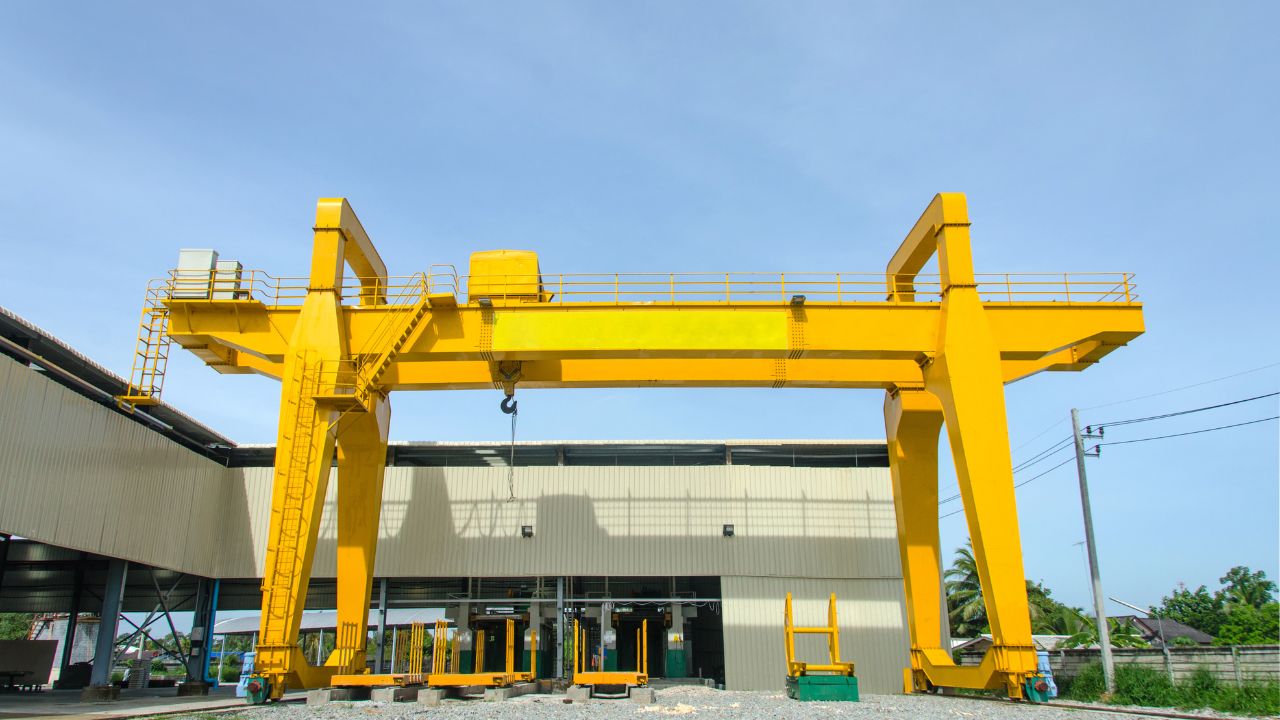
It has two parallel load-bearing beams, two portal-shaped support legs on each side, a crane trolley, a trolley traveling mechanism, a driver’s cab, and an electrical control system.
It is heavier and more expensive than a single-girder gantry crane of the same tonnage, resulting in higher transportation costs. However, you can ship the main beam in sections, along with a complete set of English drawings and remote video installation guidance, reducing logistics and labor costs.
Advantages
Equipped with a double-girder hoist, it allows for stable and continuous lifting of your goods for extended periods without deformation.
For areas prone to high temperatures, sandstorms, or coastal salt spray and corrosion, it can be equipped with the C5-M marine-grade anti-corrosion system, featuring an IP55 sealed electrical control system.
You can use it to adapt to various harsh outdoor working conditions.
Typical Application
You can use it outdoors to lift large tonnage, high-load materials. It is suitable for large steel structure plants, precast component industrial parks, shipyards, port bulk cargo yards, EPC large-scale infrastructure general contracting, large steel logistics yards, and wind turbine tower manufacturing plants.
Lifting range
20t – 200t
3. Semi Gantry Crane
Composition Structure
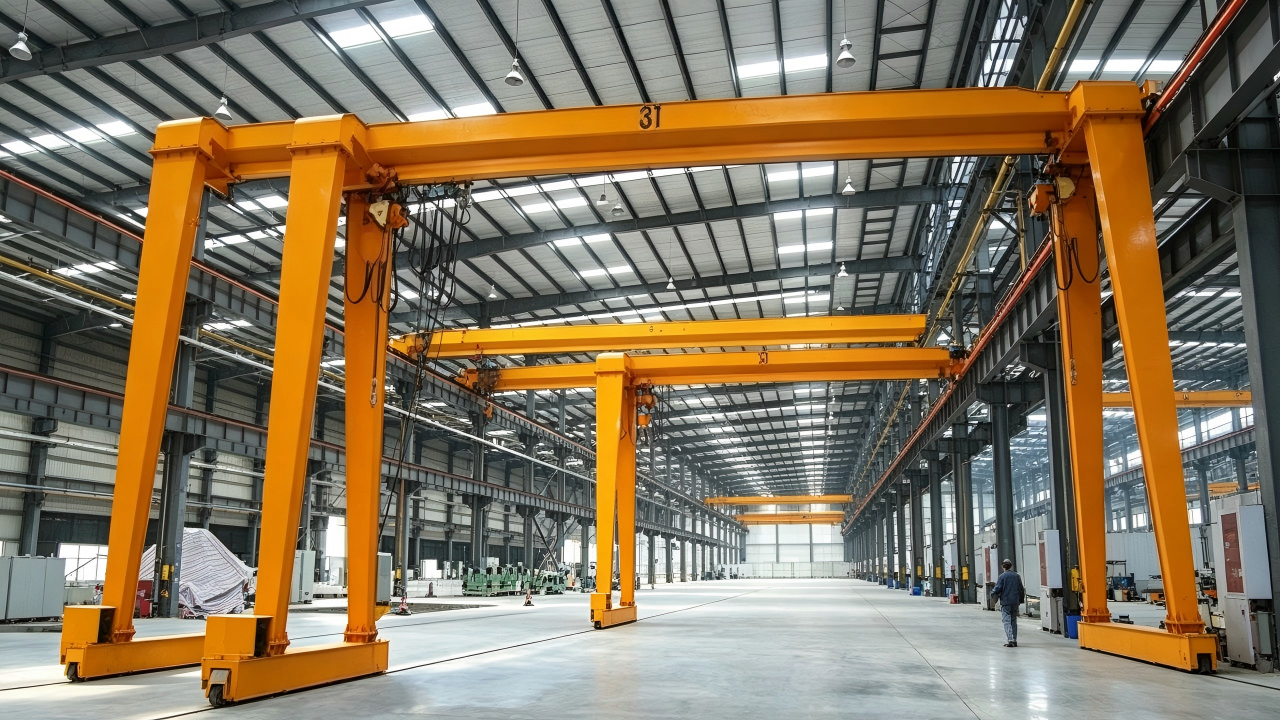
The main beam is available in single-beam semi-gantry type and double-beam semi-gantry type. The hoist suspends and moves along the main beam to lift and lower your goods. One end is supported on the elevated track of your factory’s columns, brackets, or walls, while the other end moves left and right on the ground track using outriggers. It can be used for lifting both indoors and outdoors.
Advantages
If you’re unsure of your factory’s limitations and have a moderate budget, this is a good option. It minimizes factory modifications and has a quick installation time. It can lift objects even in confined spaces.
The machine’s IP55 rating and electronic control system allow for stable operation even during long-distance outdoor work, especially when paired with variable frequency speed control and electronic anti-sway functionality.
Typical Application
You can use it in small and medium-sized machining, mold factories, and auto parts factories. It is the first choice for enterprises that are renovating old or new factories or upgrading old workshops.
Lifting range
0.5t – 50t
4. Portable Gantry Crane
Structure
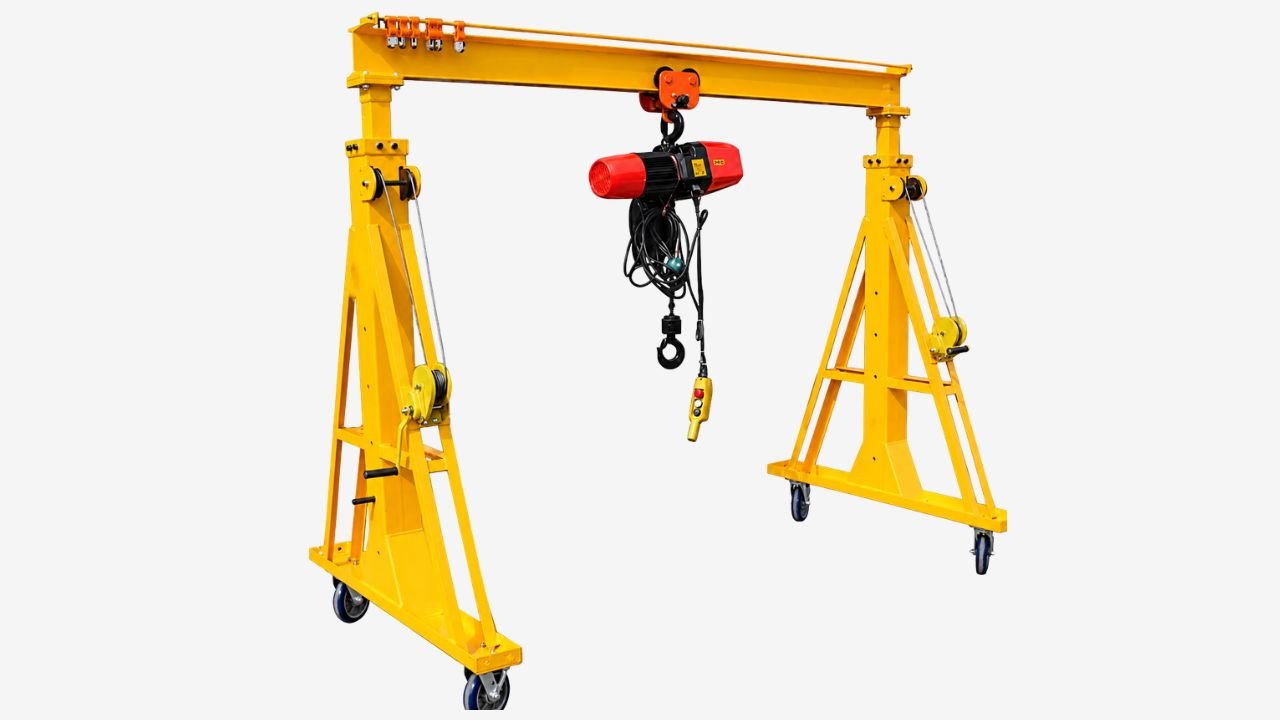
Its structure is simple. It moves using four wheels, you can easily move .
Advantages
If your factory doesn’t allow for a foundation and you have multiple locations requiring handling/frequent disassembly/reassembly, it’s a good option, offering greater flexibility and a lower budget.
Typical Applications
Suitable for low-ceilinged factories, multiple workstations, multiple lifting positions, and narrow aisles. Ideal for workshops, warehouses, and small manufacturing plants.
Lifting Range
0.5t – 5t
5. Truss-Type Gantry Crane
Structure
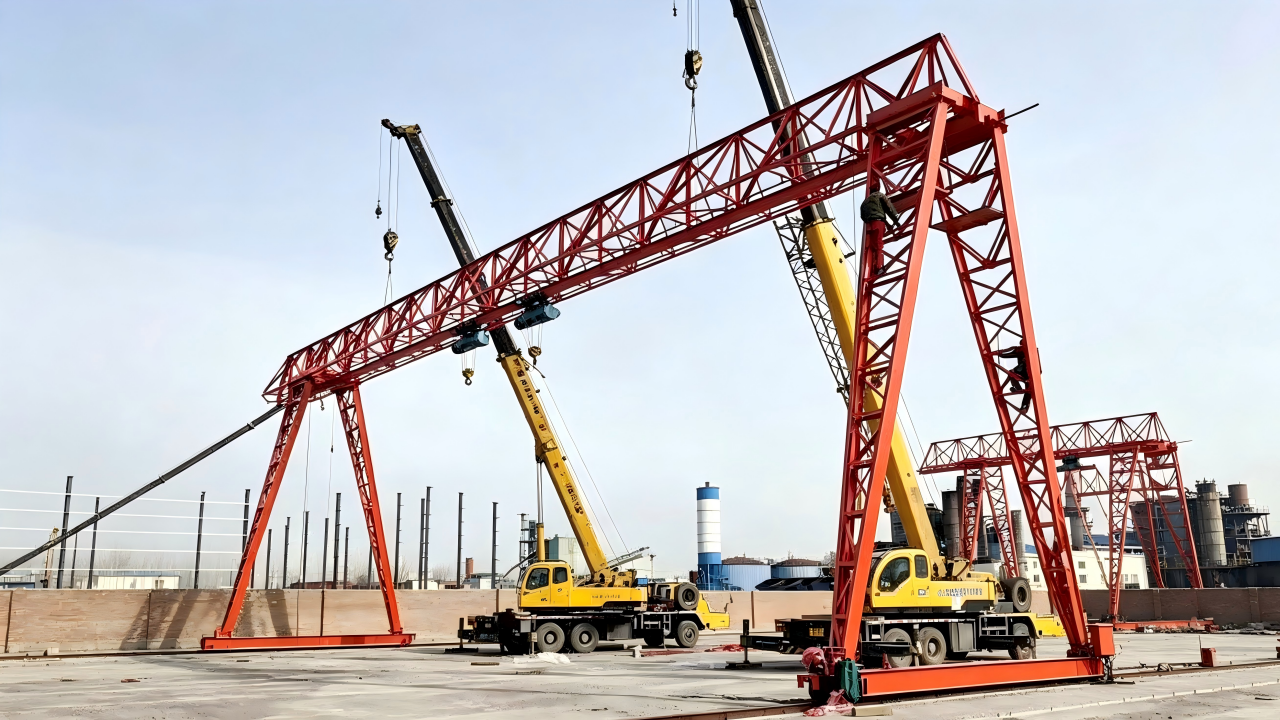
Based on the main beam, it comes in two main series: single-beam truss gantry crane and double-beam truss gantry crane. Adopts a hollow truss structure, allowing it to move on your tracks.
Advantages
The special shape and structure reduce weight by 15%-30% compared to gantry cranes of the same tonnage. This reduces your budget without compromising strength, and maintains good stability and safety in windy weather.
Typical Applications
You can use it in coastal areas, deserts, and open sites. Rely on its excellent wind and sand resistance for outdoor operations. It is widely used in open yards, construction sites, and oil and gas pipeline projects.
Lifting Range
10t – 300t
Span 10m-50m.
6. Box Girder Gantry Crane
Structure
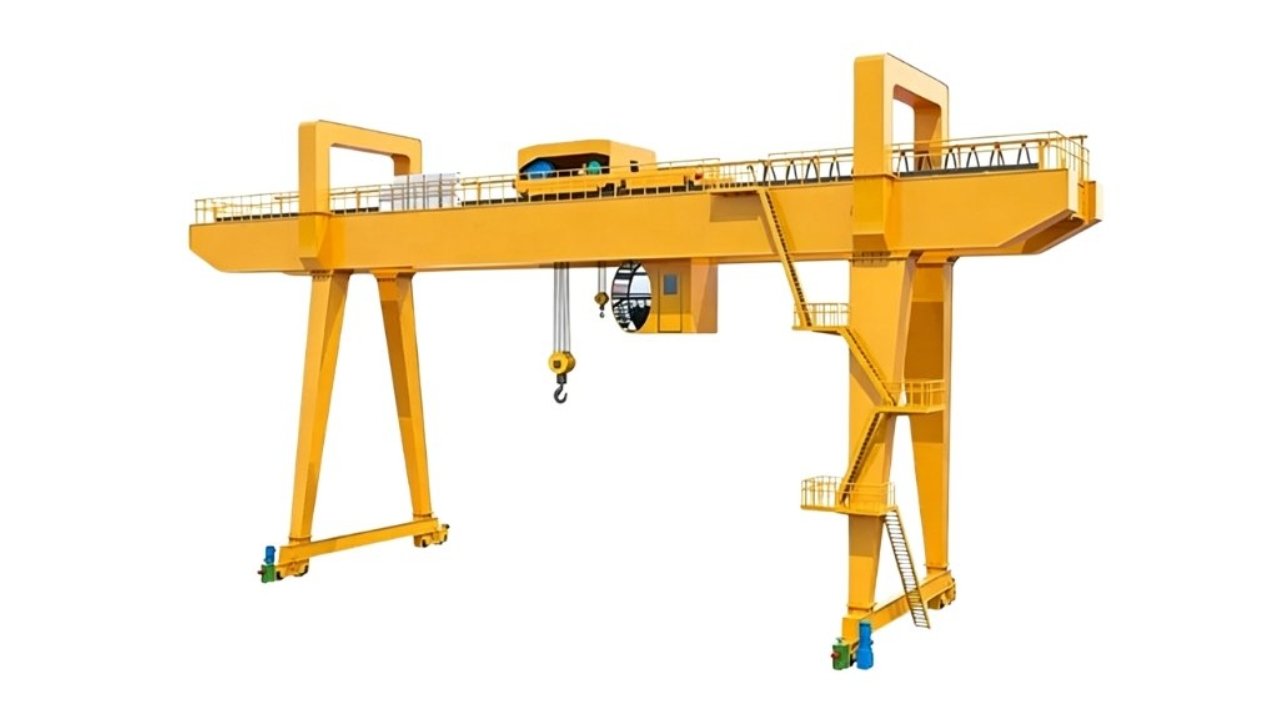
Similar to truss gantry cranes, it comes in single and double beam series. A trolley traveling mechanism runs along ground tracks at the bottom. The difference is that the main beam and legs use enclosed rectangular steel boxes, resulting in a dense structure with significantly higher load-bearing capacity and durability than truss structures. You can modularly disassemble and load it into containers, reducing your logistics costs.
Advantages
Extremely strong bending and torsional resistance, high corrosion resistance and working grade, fully capable of high-frequency, heavy-load use all day long. Excellent equipment quality,resulting in a lower cost, suitable for forever fixed use in your factory.
Typical Applications
- High-temperature metallurgical operating environments
- Heavy-duty factories
- Military and aerospace industries
- Large-scale facility projects
- Steel coil storage yards
- Wind turbine towers
- Ports
- Shipyards
Lifting Range
Standard models: 5t – 320t;
Custom models: 320t – 500t
7. European-Style Gantry Crane
Structure
Its manufacturing standards are very high, conforming to European FEM, German DIN, and EU Machinery Directive 2006/42/EC. It is a high-end mechanical product designed and manufactured in accordance with these standards. It comes in three main series: European single-girder, European double-girder, and European semi-gantry cranes.
The overall design is lighter, and you can be paired with European integrated frequency conversion electric hoists for intelligent monitoring, a more compact structure, and precise start/stop positioning.
Advantages
Although it has a box-type structure, it is 20%–30% lighter than other cranes of the same tonnage. It boasts a high level of safety, which you can use in low high factory buildings. It is energy-efficient and environmentally friendly, with a lifespan of up to 30 years.
Suitable for high-precision, high-frequency, and long-term continuous outdoor lifting operations. Easy assembly and disassembly are achieved due to its lightweight design.
Typical Applications
It is suitable for Sino-foreign joint ventures, high-end light and heavy industry, precision manufacturing, EPC, new energy, automotive, wind power, and port factories that explicitly require FEM/CE European standard lifting equipment.
Lifting Range
European-style single-girder: 1t – 32t
European-style double-girder: 5t – 320t
Ultra-large custom-made European-style gantry cranes for shipbuilding can reach up to 400t
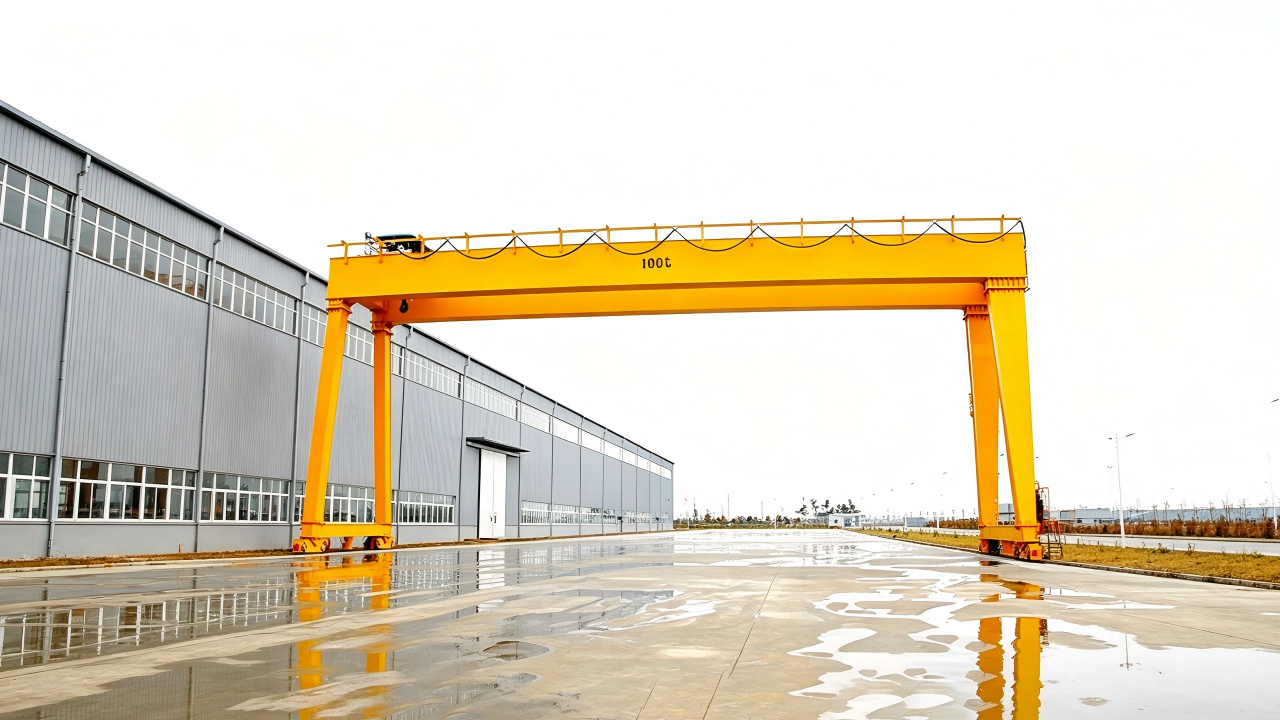
8. L Shaped Gantry Crane
Structure
It is a single-beam gantry crane with only one main beam and right-angle L-shaped bends on both sides, providing ample leg space for unobstructed truck passage. Compared to A-frame double-beam gantry cranes, it uses less steel and is cheaper, but has poorer wind resistance, making it suitable for light-duty, small-tonnage applications.
Advantages
The track foundation is simple, making it suitable you for applications with limited budgets and outdoor height limits
Typical Applications
L-type gantry cranes are more suitable for you to lift steel pipes, profiles, and long workpieces, preventing deformation of the leg steel. They are also suitable for applications with height limit in your factory or storage yard where box-type cranes may exceed height requirements. Suitable for small and medium-sized factories and building material suppliers.
Lifting Range
1t – 32t
Span adaptable to 10m – 35m.
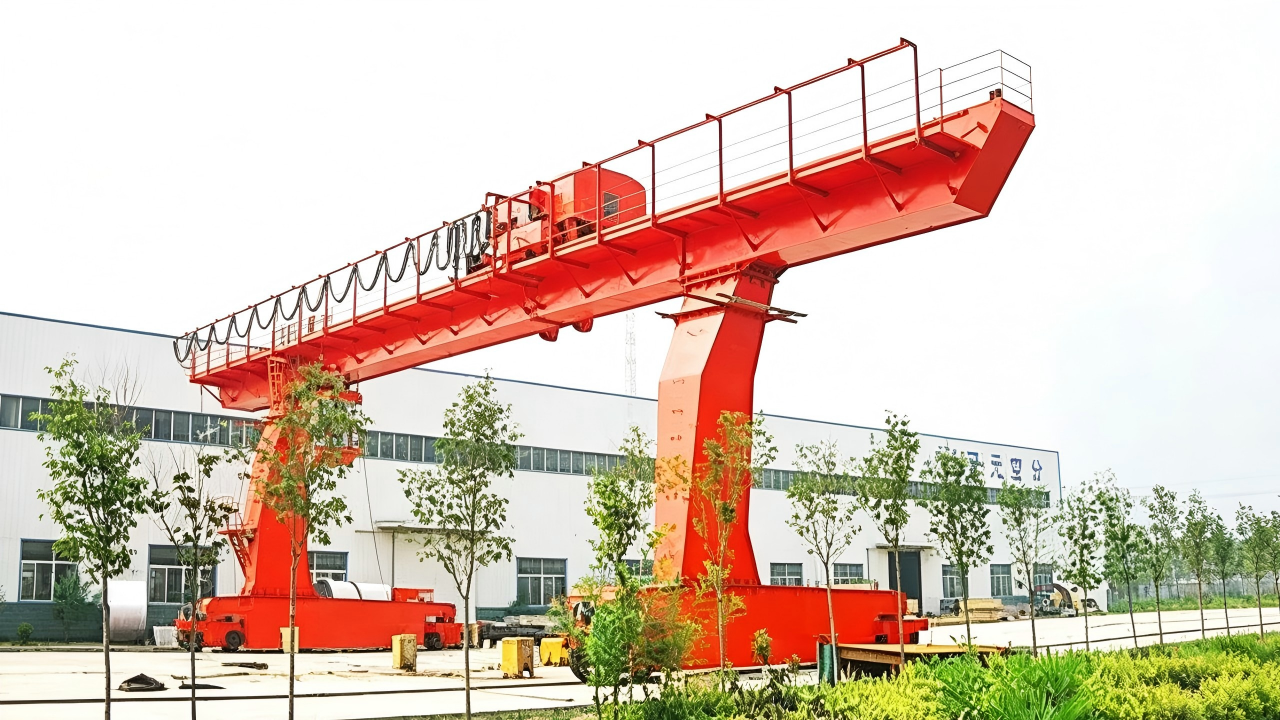
9. Rubber-Tyred Gantry Crane(RTG)
Structure
This self-propelled gantry crane operates without you pre-installed track, Driver solid rubber tires. It comes in two varieties: heavy-duty RTG models specifically designed for port containers and light-duty tire-mounted gantry cranes for industrial applications.
Its structure consists of a box-shaped main beam, door-shaped legs, a multi-wheel chassis, a lifting trolley, and a steering system, enabling free cross-regional mobility without track dependency.
Advantages
You can adjust the venue at any time to use inland small ports, temporary construction sites, scenarios requiring no track civil engineering work, and multi-zone storage areas; applicable to work levels from A3 to A8.
Typical Application
Private logistics groups, inland port operators, cross-border freight companies; overseas base station projects and bridge construction sites; small coastal shipyards and yacht manufacturing facilities.
Lifting range
Single-beam: 3t – 32t
Double-girder: 20t – 500t

How To Choose The Right Gantry Crane
This table can quickly help you find the most suitable type of gantry crane.
| Type | Span | Capacity | Working Duty | Cost | Best For | Key Advantages |
| Single Girder Gantry Crane | 5–30 m | 1–32 t | A3–A5 | ★ | Light-duty workshops, warehouses, equipment maintenance | Lightweight, economical, easy installation, low maintenance |
| Double Girder Gantry Crane | 10–50 m (up to 60 m+) | 20t-200 t | A5–A8 | ★★★ | Heavy manufacturing and frequent lifting | High lifting capacity, large span, excellent rigidity, supports dual hoists |
| Semi Gantry Crane | 5–30 m | 0.5t-50t | A3–A5 | ★★ | Heavy manufacturing and frequent lifting | Saves floor space, integrates with existing buildings, lower investment than full gantry |
| Portable Gantry Crane | 2–8 m | 0.5–5 t | A2–A3 | ★ | Workshops requiring partial floor access | Portable, flexible, quick assembly, no rail installation |
| Truss Gantry Crane | 20–80 m | 10t-300t | A5–A7 | ★★ | Outdoor applications with strong wind conditions | Lightweight structure, reduced wind resistance, material-efficient |
| Box Girder Gantry Crane | 20–80 m | 5t-500t | A6–A8 | ★★★ | Heavy-duty outdoor lifting | Excellent rigidity, high stability, suitable for long spans and heavy loads |
| European Gantry Crane | 10–80m | 1t-400 t | A3–A7 | ★★★ | Precision lifting and energy-efficient operations | Lightweight design, smooth travel, accurate positioning, lower energy consumption |
| L-Type Gantry Crane | 10–35 m | 1t-32 t | A4–A6 | ★★ | Handling oversized or long materials | One-sided leg allows larger loading clearance |
| Rubber Tyred Gantry Crane (RTG) | 23–100 m | 3t-500t (under spreader) | A7–A8 | ★★★★ | High-volume container handling | Rail-free movement, excellent mobility, high yard efficiency |
FAQ
How does a gantry crane work?
Gantry cranes use electric hoists to lift and move heavy objects. The trolley moves horizontally, and the crane moves along tracks or wheels, thus transporting materials safely and efficiently. Personnel operating gantry cranes must receive crane operation training. Before powering on, ensure all safety procedures are running.
What type of alarm is used on a gantry crane?
Most gantry cranes are equipped with audible and visual alarms, flashing warning lights, and overload alarms to enhance safety. You can also equip them with travel alarms, emergency stop systems, and collision warning devices. These alarms protect the safety of operators, nearby workers, and equipment.
What is the difference between a bridge crane and a gantry crane?
Bridge cranes do not have four outriggers and rely on brackets and rail beams for operation, making them ideal for indoor factories. Gantry cranes, on the other hand, have outriggers and run on ground rails or wheels, making them more flexible and suitable for both indoor and outdoor lifting operations.
What information do I need to provide before I can provide a quote?
- Lifting capacity (maximum load)
- Span (distance between the rails or legs)
- Lifting height
- Indoor or outdoor application
- Working duty (A3–A8 or expected operating frequency)
- Power supply (voltage and frequency)
- Site conditions, such as wind speed, temperature, or corrosive environments
- Special requirements, including remote control, anti-sway systems, explosion-proof design, or customized lifting attachments
How to operate gantry crane?
Gantry cranes can be operated via handheld controllers, wireless remote controls, or controls located in the cab. Before lifting, inspect the crane, secure the load, and ensure the work area is unobstructed.
Operate smoothly during lifting, avoid overloading, and move the load carefully. Always follow the manufacturer’s operating and safety instructions.
Get Your Customized Gantry Crane Type From DINGYA CRANE.
Dingya Cranes specializes in the research and development and manufacturing of gantry cranes and related lifting equipment suitable for various heavy-duty, high-frequency, and complex industrial and mining scenarios, enabling efficient and stable lifting operations. We will tailor a unique lifting solution to your specific needs.